I currently am employed at Hobsonville Point Primary School where I work in a year 5-7 learning common, this is my 8th year at HPPS. I teach, lead and learn. Previously, I spent 3 years teaching at Henderson North School with a class of Year 5-6 students.
“I’m really pleased to be out of Auckland,” my daughter shared. I smiled, we were waiting in the car at Hamilton Hospital, while Hillary, her Mum, was visiting my father-in-law. We were on our way to New Plymouth, where my mother-in-law was also in hospital. Her sense of positivity was exactly what the article in front of me was referring to. There has been much to bemoan during this pandemic, but as leaders, parents and teachers, keeping a lid on this is important as we mitigate our impact on others.
Somewhere between the realisation that lockdown 5.0 was going to be a while and the incoming Education vaccination mandates, I made the decision to filter negative energy. I was worried about my own energy spiralling and the affect this could have on my own family, class and my colleagues. Misinformation, politicking, poor weather, and distance teaching had me in a funk. As I started to get some clarity on my own personal response to these variables I looked for a way out, a degree of filtering was needed. Choosing to engage in anything that was going to facilitate a downwards spiral would be destructive. However, choosing not to engage is only part of the solution as friends, family, colleagues and the wider public can decide to interact or focus on topics that are intensely challenging. A simple tool at this point is understanding your own pressure points or triggers, whilst having a range of exit strategies prepared in advance of difficult conversations.
Lounging in the sun this Boxing Day, I chatted with family. There was widespread agreement that leaders in this period are often faced with two choices and both of them are rubbish! No question that this period has been difficult, in schools there is constant pivoting as the situation changes. Compounding this,changes take place in a setting where all stakeholders are highly charged.
With every email, request, reflection or instruction from those around me, I’ve needed to step back and consider my responses. What is being asked? What is the purpose? What lies behind the words? What is the impact on others? What is within my sphere of influence?
Each lockdown HPPS has felt well prepared for the different variants. Documentation has been available, much pre-thinking has taken place, distance plans or templates ready to launch and the mindset of staff, while anxious, has been largely positive. Phase 3 felt different, Omicron forced a dynamic environment, with high numbers of cases, the ability to close classes rather than whole schools and limited relievers reducing capacity to cover isolating teachers. Covid fatigue is higher amongst children, parents and the teaching community too. From the onset of the teaching year, teams have been readying themselves. Are students prepared with online and offline resources, devices and account details? If I had to take a RAT test and find myself or my colleagues needing to isolate where would we be placed?
The world has been getting on with things, NZ has slowly played the cards it’s been dealt and ever so slowly we’ve put one foot in front of the other. Of course social media has provided some assistance too with plenty of interesting reading available (this one was great), such as the following visual.
This term has felt lengthy, necessary measures have left many feeling exhausted, isolated and looking for easy solutions. Perspective has been important, others have done it rough, and others have had it tougher still. But as we approach the end, through the fog I can see the light and I feel invigorated. Around me magic is happening, this is inspirational as we look to spiral up and onto the next thing. My own team is reflecting, deconstructing our successes and our wonderings but giving ourselves permissions too.
This post is a part of me looking forward, backward and all around as I reflect. I’m trying to keep it real, pragmatic, and continually looking for the spark.
I loved buying my colleagues coffee and showing them they were appreciated. Avoidingsocial media, keeping some thoughts for a select few and constant reminders about icebergs have all helped. Trying to find magic has also kept me super positive. What strategies do you utilise to keep it real during these times? How are you ensuring that you’re looking forward and being the best teacher you can be?
"I want to be a fairy." She grinned as she said it. "But not an ordinary one, one with a job, like the tooth fairy". My little 5 year old had let me know about her future plans as we travelled in the car.
We all have an idea of who we want to be. Its a question that children are asked by teachers and parents and as children we all have kinds of responses. So fairy was an acceptable response for a doting father, especially when followed with a great explanation. As a 17 year old being a teacher was the furtherest thing from my aspirations, and the poor english teacher who suggested it received the type of disrespectful and tactless response that now make me cringe as a teacher. That 17 year old is still there, deep inside. But the 17 year old is mitigated by the love and knowledge of being a father of two, experience in a range of different industries, and the product of professional development, experience and challenges his early 40's self values. I have a strong awareness of the teacher I desire to be. What I have come to learn, is that my identity as leader is less clear. It may even be an identity crisis.
My experience of leadership is quite divergent, I'm fortunate to have worked for leaders in a variety of industries, organisations and titles. These have included General Managers, CEOs, Owners, Principals and Heads of Departments, and to steal a phrase, I believe I've seen the good, the bad and ugly. My own experience has included leading teams in retail and academic settings. So it was with eyes wide open that I took on some leadership responsibilities at Hobsonville Point Primary this year. I recognised that there would be obvious challenges in the range of communication, organisational and emotional demands that come hand in hand with leadership roles. I also anticipated that there was also going to be an element of things that I didn't know. Eyes wide open, but no idea of the leader I really wanted to be.
I spent the holidays reading some introductory documentation and considering goals. Self-knowledge is invaluable, choosing goals to provide some direction in response to what I anticipated was a useful way to walk into 2019 and could be considered in terms of my HBDI profile (shown). However, it was two conversations early that resonated more, possibly even foreshadowing the impending identity crisis.
Meeting with two colleagues socially, I was taken aback when they mentioned the language of love, "Do you know your love language?" they enquired. Surprised by this sudden tangential shift, I stammered out my naïvety. As they explained what it was about how this affects them as teachers I began to see their point, knowing your learners as a leader is just as important as knowing your learners in the classroom. A little professional reading proved enlightening (https://www.5lovelanguages.com/), I could see how love languages and knowing how other teachers functioned could be part of the toolkit. But as my colleagues and I had talked that night one of them shared an important and more serious insight, "Reid, you don't have to always have the answers. Take time if you need it, it will be ok to say you're not sure".
Early in term 1, meeting formally with the leadership team, Daniel began with provocations about positive and negative experiences of leaders we'd had in the past. Three leaders stood out for different aspects I admired, several others provided examples of things I would work hard not to emulate. Reflecting on the positive qualities was somewhat useful, but it was the notion than these people were vastly different in their styles and how they impacted on my own learning. Like a recipe, it was taking these positives and adding them to the recipe of creating my own leadership style.
The emotional aspects of dealing with people I find extremely challenging. I can be quite a blunt person but have developed a certain resilience alongside this, other experiences being blunt have taught me that if I want to live by the sword, I also have to die by it. Age (and emotional intelligence) has improved this personal trait, but I still find it hard to read body language. The combination of shooting from the lip and not reading body language is unfavourable, especially when talking with colleagues whose own thinking preferences favour emotional responses first. As a tool to help me with empathy and understanding I've read the Elephant in the Staffroom. It definitely helped as it provided an insight into the triggers for teachers in general and framed the emotional responses in several useful ways that I've considered as I've gone through 2019. My own emotional responses (which can be blunt and irrational) require management also, I don't want to jeopardise the working relationships with my colleagues or senior management team. I'm prepared to be collegial and have difficult conversations, but am finding myself taking more and more time to map out conversations in my mind and seek feedback on these conversational maps. The reading of body language and getting better at just listening has improved (the nail in the head video helped, as did The Elephant In the Staffroom). I certainly hope my abilities with this has improved but only my colleagues could truly tell me if this has improved.
What does leading in a collaborative space look like? It certainly does not look like me getting my own way and in fact, if this was the case then I'm sure the students would be missing out. I'm fortunate enough to teach with two other experienced teachers, we all have good self-knowledge but with a fair dose of our own strengths and growth areas it creates a space where there is lots of robust conversation in regards to process, choices and anything and everything that being a teacher encompasses. It is certainly not an echo chamber and nor does it demonstrate a high degree of group think, many conversations require clarification, processing time and at times things have needed to be parked in order that they can be reviewed later. Within this though, I have to admit that delegation/stepping back in some areas continues to be a challenge. Because of the experience that I'm surrounded with I know that some tasks can be completed or led by either or both of my colleagues, learning to let them do that has been a journey, as has asking them to give me some space in order that something else can be completed. Amusingly, my principal has at times asked me if I'm at the point that I need to offload something and I smile and think about the pot and the kettle.
Recently, my own leadership wonderings have been around communication, data and the effectiveness of teams. As I got through my mid-year appraisal, I was challenged to rethink my goals and agreed that I was looking for something gruntier within leadership. Partly based on my own desire to soak in as much as possible, I've been doing far more listening than sharing, especially in leadership meetings. But with an interest in all things technological, a need to develop a more analytical approach to leadership and growing our school capability in reporting, I've decided to focus on building my own capabilities in school-wide and year group level data analysis. We're in the initial years of working with Linc-Ed as a reporting system and school management system. While Linc-Ed has a huge amount of potential, pragmatically it is still a very new system and as such we need to grow our school's intellectual capital with this product. This allows me to develop a better understanding of how the data is informing our school while at the same time learning more about a technological tool, I can pass this knowledge and processing on quickly as I find it relatively easy to upskill with technology.
Collaborative leadership can be challenging in regards to both communication and the effectiveness of teams. Getting the balance of communication correct is essential to moving your team forward, I'm not naive enough to think that this is solely about my leadership but it does bear thinking about. Setting teams up for success in meetings, informal conversations and one-on-ones is crucial and a large part of this requires effective communication. In a full team meeting I've had up to 15 staff, with student teachers present, and in a collaborative space there is lots of people wanting/expecting to have their say. It's imperative that everyone has a voice in order to encourage buy-in but is this effective? Arguably, it's not, or not all at the same time. Especially when you consider the different personalities, processing, and preferences that are at play. Hence, my beginning feelings about communication. Furthering the need to focus on communication is our school initiating it's 4 minute walk throughs again, this time I'm facilitating teams as they walk through and it is important that I lead and model these reflections appropriately. I've been looking into two different texts as a source of learning, the first Collaborative Leadership, where there is a great section on communication and secondly, The Power of Teacher Rounds to support facilitating the walkthroughs.
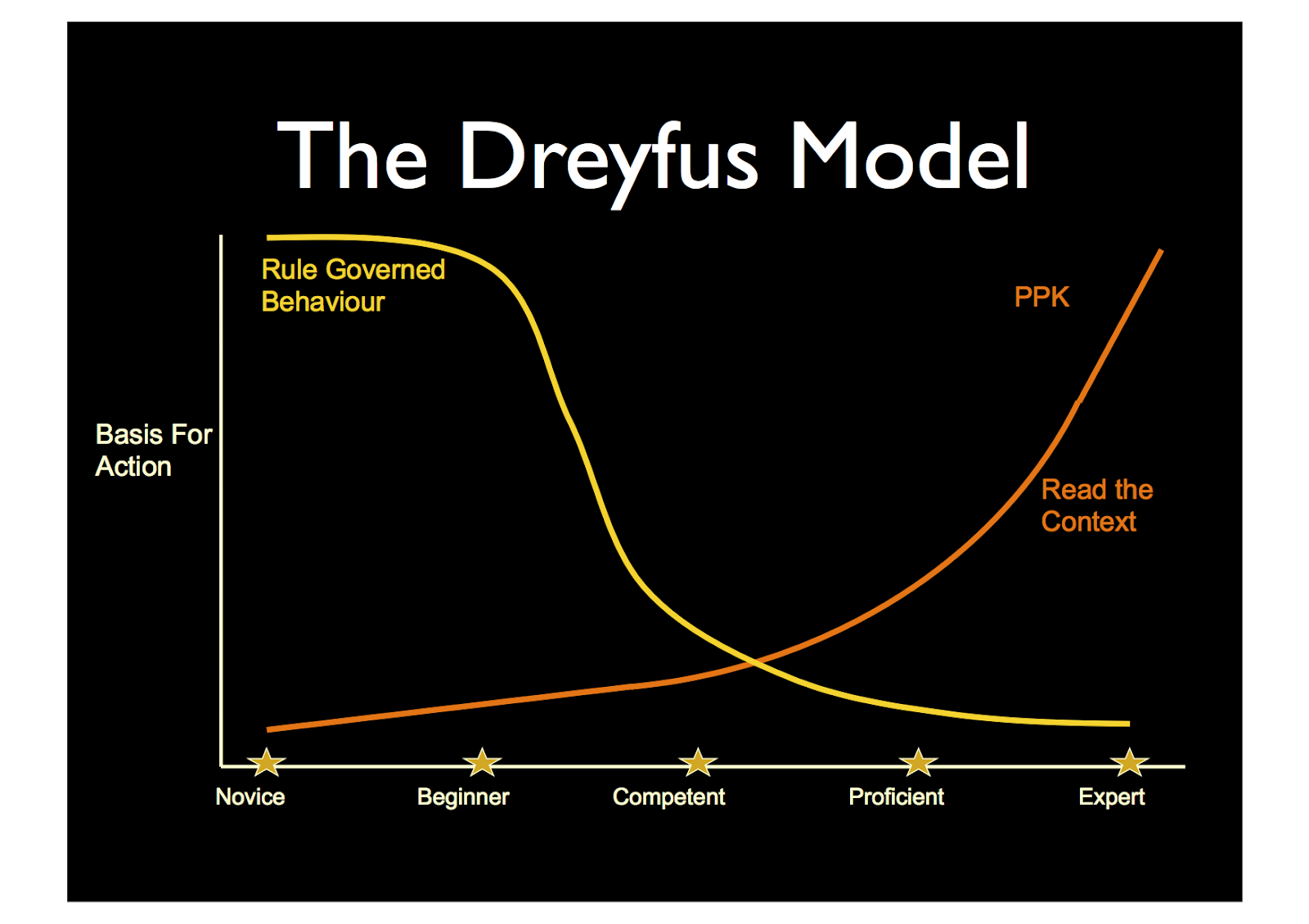
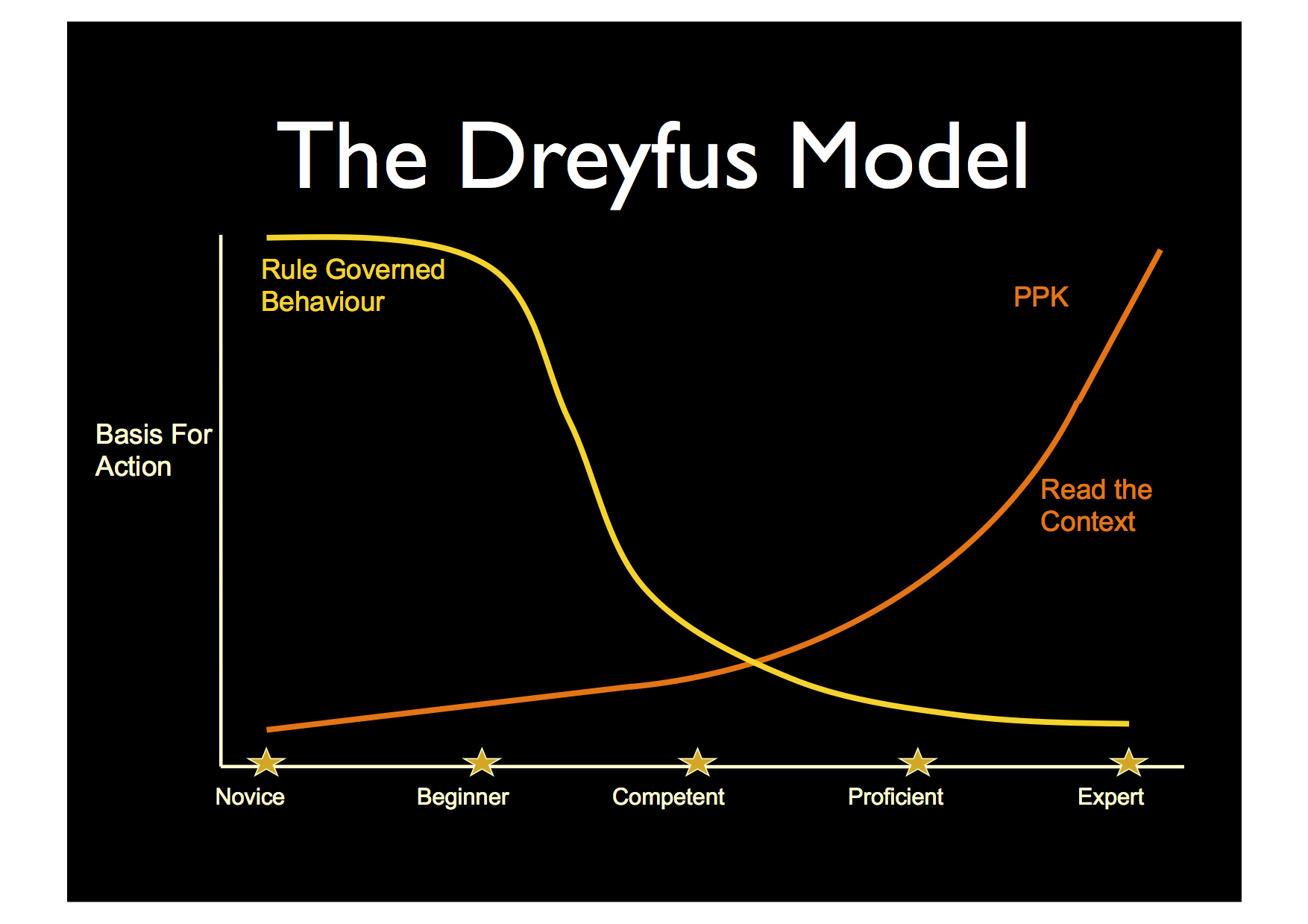
During my time at HPPS I've also had the pleasure to meet a number of the staff at Hobsonville Point Secondary and they too have provided all sorts of learning. Many of these Hobsonville Point staff, both the primary and secondary, have inspired, challenged, and given me opportunities I'm very thankful for. At other times though, I sometimes revert to type or back into the familiar (consider the Learning Pit and Dreyfus model) and comfortable, and forget to push forward with my own pedagogy. It is in the continual push forward that I become excited as a teacher, it sparks me with ideas, wonder and awe that I can then transfer into the classroom.
But this brings me to the crux of my identity crisis. Is Reid the teacher, the same as Reid the leader? Are these two people congruent, mutually exclusive or just reflections of each other? Is it ironic that many of the conversations I've had with leaders throughout my time teaching, are the same conversations I've had with others as a leader this year? It has me sometimes questioning the narratives I hear, what would I have meant if I was using the same narrative? Is this what they mean or is there a prevailing discourse that I should consider or coach for? Early in the year I had some quite significant insecurities around leadership, I know that my seniors were aware that I wanted to be seen as capable by others. Not in a deliberate, completely insecure way, but I was fully aware that if my behaviour, language, and all the components of Reid the teacher, role modelled someone who was lacking capability, then it was unlikely that teachers would look to me for support. As 2019 has progressed I've become more comfortable in my own abilities, while I still suffer from bouts of self-doubt, it is not capability-based. In preparing this blog post, I happened across the Congruence Model again, something I was vaguely familiar with but it led me to the Leadership Shadow diagram and someone else's blog. The model resonates, and the blog that is attached contains many useful reminders of things that have an impact on your leadership shadow. Implicit in the leadership shadow, is the difficulties facing someone in collaborative leadership in a de-privatised classroom, the teacher and the leader can be one and the same, affecting each other no matter how you strive to seperate them.
Amongst my own learning has been the regular observing of a secondary colleague, every time I meet with him I find myself invigorated with an innovative edge. He reminds me of all the things that excite me about teaching, but his ability to transfer this knowledge and expertise and inspire others allows me to believe that the identity of the leader and the teacher do not have to be mutually exclusive. I need to push forward both as a teacher and as a leader, and also consider what that looks like for members of my team. In my role it is necessary to continue pushing and evolving teaching staff to build their own capacity. This is where knowledge of others becomes so crucial, the ability to read body language, understand the nuances in their behaviour and communication so that the right challenges are made at the right time. I won't naively assume that I've got this aspect right, but my own knowledge of the importance of this feature is evolving, the mere fact that it is top-of-mind allows it to be part of my toolkit.
So, where to next? Professional reading, regularly attending coaching sessions with the senior leadership team at HPPS and availing myself of time with teachers and leaders I respect is key to building my own capacity. Continuing to read and learn from avenues outside of education is also important, both as a teacher and as a leader. I count myself lucky that all those I respect see leadership and growth as a journey. Thanks to all who have contributed so far, your ongoing patience, humour and willingness to be part of the crew make it all worthwhile.
My daughter is five and three quarters. Not five! One of her dreams is to be a tooth fairy, not a made up fairy like a doll, but a real one with a job who gives money to children for their teeth. It's quite a convincing job and is a stark reminder that a little magic is a beautiful thing. As adults we often lose the magic as the mundane and routine takes over, as teachers routine is equally undesirable and yet is also a key to success. Finding the moments of magic can be why many teach, but creating them is just as challenging as spotting that damn tooth fairy. Teachers are harsh self-critics! We're always looking for something better, a more effective or efficient way, a new teaching point or maybe even just a more interesting way of doing things. In doing so, are we creating the right conditions for magic or is it happening in spite of us? As a new school we're still developing systems, styles and knowledge with how we approach various aspects of teaching and learning. One area we have been developing our capacity is in the HPPS approach to topic/inquiry learning. We call it Immersion, you can read more about this in an earlier post from 2016 after Daniel and Lisa had challenged us all to engage more with the head (brain), than just the hands (hands-on, authentic learning) and heart (memorable experiences). In my time at HPPS the systems we use for planning this have changed considerably, the changes have been the foundation of several teacher-only days. With some of my colleagues we've reflected on whether or not we were getting the planning and teaching right for immersion. More recently, Daniel's challenge has been on how each team measures success. Unquestionably, getting the planning and teaching for immersion right is largely down to teacher input, our reflections weren't questioning management more whether we were getting the process and therefore the planning right. Was Immersion leading to powerful learning? Was Immersion leading to powerful projects? How do we know? As we entered another TOD, I felt uneasy about our most recent round of Immersion/Projects. For the most part the project phase had left me flat, with very little curiosity or wonder amongst the students, and generally a bit of confusion around what they'd learnt. Where had we gone wrong? It's easy to blame the documentation or the process for planning, in fact it's too easy (fixed mindset where capability and adversity is shifted away from the owner). We knew the planning process had been been undergoing slight changes every rotation for a couple of years and this does create cognitive dissonance, as there is very little room for developing expertise within the system (see the Dreyfus Model, ie we were still in the novice/beginner phases). I also know that the self-critic was being unfair if I recall the success with which we'd finished 2017 (see Return of the Moa post). I feel fortunate that I had several powerful discussions preceding this TOD, with a colleague we'd reflected and been self-critical but then discussed the additional expertise we could take into the next planning rotation and help to create more powerful learning and a conversation with Lisa where she'd shared some of her thinking as she considered a whole-brain approach to the planning (see photo on Hermann's Brain)
This was challenging but positive, I can become a bit silly with ideas (one ideas breeds another and then I'm excited), rather than a risk-taking, creative and imaginative focus, I wondered whether a holistic, synthesising, and big-picture approach was required? To help myself and my team, we'd gathered some student voice on what they wanted to learn about (see photo) and I'd had a brainstorming session knowing the general theme (Systems and Science - easy to think Solar System or Body Systems) but this wasn't the desired outcome as this was choosing based on an idea rather than the holistic thinking Lisa was seeking regarding Systems. Where would we take our students through immersion if we thought about a more encompassing idea of systems? We were provoked with this video: This still isn't enough to guarantee success though! Lisa's leadership on the TOD compared immersion to a geographic location. As teachers we have the power to differentiate the learning experience so that different children may experience a variety of activities, whether by this is a result of interest, learning need, curiosity or because of their dispositions. This in turn means that some may stay in the immersion phase throughout projects, while others transition earlier to the project phase.
Source: Lisa Squire.
Our team planned, reflected, challenged, wondered, sought feedback, took some risks and produced a rather shot-gun style planning document. But I feel it's been integral to our success this round. We've had a very clear idea of what we want to achieve and teach but have allowed enough room to be responsive to the needs and interests of the class as they develop. Ultimately, we've collaborated! Any of us could have planned and taught the immersion topic individually. However, I doubt it would have been as effective, as the collaboration has contributed additional value compared to the individual expertise. Relationships have been important too, knowing the children, their needs, interests, recording their student voice before entering. Developing our own systems for their success throughout the day and personalising their learning so that each could navigate the immersion island in their own powerful way. One of the activities we'd forward planned was for some work on assumptions, did we have those children who literally thought that milk came from the supermarket? Salt was the amongst the first assumptions to arise, someone had wondered if it was made from flour, but this had been preceded with the observation that "all foods have ingredients, but where do the ingredients come from?" The magic that has happened is born of these ingredients: relationships, collaboration, planning systems, reflection, teacher intellectual capital and a fair dose of teacher passion. Having the ingredients and creating the right spell/recipe can be quite separate however, this time we've just got it right as a teaching team and I hope that we can repeat it in the future. While we've taught, provoked and immersed our children into this world of food, they've responded with enthusiasm and curiosity. They've shared their wonderings about the intricacies of their digestive systems, or their taste buds, they've been designing the most amazing cakes and talked about "synthetic" cheeses and questioned if milk is the liquid and cream is the solid. For projects, they want to run Master Chef and bake Extreme Cakes, they want to learn more about their taste buds and learn about stomach acid. A non-writer is wanting to write a recipe book, another is sharing his cake designs and using actual measurements. Teachers are happy, proud and feeling like something positive is happening. Magic is happening! Planning is easy, most teachers can complete a topic planning outline to a reasonable degree. Turning that recipe into something magical is more than just the right ingredients and resources with a healthy seasoning of teacher passion. It might just be timing or having students who are receptive to this topic. I suspect that if I reflect enough I can unpack a myriad of rationale for the contributing factors, but like my daughter I choose magic! There is a synergy at work this immersion that is greater than the ingredients, it has raised the bar in LC5 and I await the project phase with excitement. What will this magic create?
Two teachers bouncing ideas about how to merge technology, drama and dance in a performance
Three teachers questioning if they could make it work in the timeframe,
A principal challenging his staff to add value and learning for the students,
Students raising excitement levels as they share their wondering, "Could we do a play?!"
Student teachers offering to do choreography and script writing, taking responsibility,
Children brainstorming ideas, "I can add to his idea by..."
12 learners writing a script, that their peers and teachers contribute ideas to afterwards
5 writers sharing a play, getting feedback "Are we going to do this?"
Associate Teachers and Student teachers performing the play, modelling failure, high stakes,
A learning common listing the jobs and thinking of teams, "We'll have to do more than one job"
Timelines that challenge students to work together,
Acting group creating more speaking roles and adding to scripts,
Parents offering support, materials, time and expertise, Students choreographing dance numbers, supporting their team mates
Children analysing scripts, props identified, backdrops considered, costumes imagined,
Cast members helping each other learn lines and cues, new friendships made
One team member offering an idea, others adding to it "We could build on that by doing this"
Giving constructive feedback, "If use that idea, this might happen.."
Learners coming to school with props, costumes, materials to contribute to the performance,
Students staying after to school to talk through ideas with teachers
A marketing team creating posters, generating an audience, selling tickets,
ESOL teachers using prop making as oral language lessons
Problems identified, other staff or non-LC2 children solving them,
Children sharing how they're in the pit, peers helping them get out
A learning common making sure all the jobs get done, deadlines met, "Will this come together?"
Dress rehearsals, everyone has a role, more jobs still being found,
Technology team setting the stage, parents helping
Stage managers helping the cast get their props
Dressers helping actors change costumes
Ticketing team welcoming people to the show
Parents and staff children preparing the refreshments
Ushers showing an audience to their seats
Sound team reading scripts to ensure cues are hit
Actors, dancers, stage managers, singers, directors, leaders and learners all,
An audience clapping, collaboration shared and appreciated, successful.
Students beaming, celebrating their effort and the rewards. Together.
A stage cleared, costumes put away. Venue empty.
4 teachers, 3 teacher aides and relievers all working on the same goal
77 children all working on the same goal.
"It's all come together"
"This looks awesome, we've done all this and we're just 7 & 8 year olds and we've done it all in 9 weeks! I can't believe it has all come together".
Return of the Moa. LC2 Collaboration. Lifelong learning.
Fridays at Hobsonville Point Primary School have traditionally become PINs day. Most of the school chooses part of the day to focus on Passions, Interests and Needs (PINs). Students plan, resource, lead and reflect on workshops that they deliver to their peers. It has been led by the junior learning commons and filtered up through our school and although my initial experiences with PINs weren't convincing I'm quite satisfied with the impact it has on learning these days. The impact of PINs on teaching HPPS students our dispositional curriculum is complemented by extending the reach of the more academic learning, reaching into areas like the English Language Learning needs of our ESOL students, displaying aspects of Tataiako and fosters relationships with our children's Whanau.
Student-led learning is not new. It has always been valued at HPPS through the use of student-led workshops and responsive teaching. Similarly, at other schools projects, passion based learning, public speaking and the notion that there are many experts in the room have allowed teachers to allow for a more facilitative approach to teaching. We are definitely not the only expert in the room! Tataiako, formalises that for NZ teachers and promotes the valuing of the intellectual and cultural capital that Maori students in particular bring to the classroom, but is extrapolated to all students as a model for effective teaching.
HPPS has promoted student-led learning from its beginnings, through the promotion of student-led workshops. My first powerful experience was when a student came to me and asked if she could run a lesson to help some peers with their keyboard skills, that afternoon she ran a great workshop using Dance-Mat Typing. Projects also would see students helping others with things they needed, for instance iMovie skills, Google Draw, writing an information report or drawing a graph.
PINs is different, it plays on the hearts and minds of our learners. Asking students to share their passions and interests allows them to share their hobbies, habits, activities with their peers. Students submit their workshop plans during the week, we select the plans to be used, students opt into the workshops and we then supervise them. The next week it all happens again. Our 5 year olds are running workshops, teaching their friends about things they value. All manner of topics get selected, art, dance, sport, language, drama, computers to name just a few.
What might you see at HPPS on Fridays? You might see children playing in the playground, working in our learning commons or you might think it looks like organised chaos. Probe a little deeper, ask a few questions, reflect on what you know about learning and a very effective part of HPPS is taking place.
Students are eager to get their plans selected, throughout the year this encourages an up-skilling in their instructional writing and may even be their first introduction to this type of writing. In choosing to run a workshop many have negotiated with friends to decide on a topic. Once their plan has been selected, students opt in, head off to workshops and come back eager to share their learning. For the students running workshops they've needed to prepare their teaching resources/equipment, negotiate with others for teaching space, deliver content, manage the behaviours of their peers, manage time, solve conflicts, it is an absolute treasure trove for our dispositional curriculum. Do workshops go wrong, absolutely. But this just facilitates discussion on communication, resilience, perseverance, reflection and what the student might do differently next time.
If you were to see an art, language, science based PINs workshop, it is clear that learning is taking place, in others the learning is a little less evident but present nonetheless. Consider some of the drama or play based activities (Duck Duck Goose anyone?) a student might choose, to have ESOL students running these workshops and practising their oral language is a great reason for such an activity to go ahead. In talking to one of my peers in a junior class (Year 0-2) she said "they'd had enough colouring workshops, it was time for students to up their game". Her students needed to be doing a bit more, it had been acceptable for some first-time workshops but the expectations had clearly been elevated.
Parents come in to help run PINs also, this year we've had Mums and Dads helping their children run workshops cooking, doing science, sewing, sport and sharing their culture. Allowing this encourages stronger relationships with families as we open our doors, they share their values and also get to see a little part of what makes their child and his /her peers tick. A colleague reflected today that she believes the difference in engagement with PINs between our commons may even be due to parent engagement, opining that they only run PINs fortnightly and she wonders if it is a reflection on the lack of parent involvement.
I've recently become another teacher with children at school, which has resulted in a philosophical and emotional shift from the role of teacher. PINs has been part of this also. PINs was top-of-mind as we considered an educational choices, how would our darling daughter be able to celebrate her passions and interests? I imagined yoga, gymnastics and cooking workshops appearing in our future. It was to my surprise that in her first week she was running a session on some app, to my knowledge she had never seen this app. As I considered the possibilities I wondered about the use of these workshops to build mana amongst a student's peers. I suspect this may have what the learning advisors were thinking, as a Dad this would be a suitable motivation. Abby's excitement about her first workshop was Christmas-like, with the visit of her teacher-aunty to HPPS she quickly roped her in to help with another workshop.
Occasionally, we as teachers run workshops during this time too. We will opt students into a workshop because of a need, e.g., handwriting or tying shoe laces but our most effective one this year was when my colleague suggested a meeting with our Maori/Pasifika students. She begun the meeting explaining that she was sad that a recent cultural project in the learning common had focussed on many other cultures but that Maori and Pasifika wasn't getting the mana it deserved, what could they all do about this. This group have now introduced several waiata to the common and have created a class culture of singing after lunchtime.
The role of teachers in these sessions alters based on the needs of the individuals running the workshops, our ESOL support have chosen to run workshops alongside students or just be a member of the workshop. Some students require assistance with managing the set-up, others during the actual workshop. Occasionally, there are reports of someone not doing what they're supposed, again this just becomes a chance to lead a conversation with all parties. More often than not, its directing students how best to manage their time or their peers. We've taken the opportunity of PINs workshops to provide disposition-based feedback/forward to students, at one stage we tried to make this written feedback but like most feedback it needs to be passed on in the moment to have any impact. As another means to generate reflection fodder, we've provided the opportunity for students to complete a Google Form (as shown).
There are many ways that students get to leverage their intellectual capital in the classroom and this is only one. But in classrooms where student voice, engagement or agency are not being fully explored or utilised then PINs presents as a possible mechanism for opening up student-led learning. Our children love PINs, it's powerful and is a fantastic opportunity to allow students to lead their learning. "I like how we get to learn lots of different things and we don't have to do just reading, writing and maths everyday" (Janneke, year 2).
What are the vital ingredients that create a successful team in a collaborative spaces?
Beginning my third year at HPPS and once again being a member of a new team, this thought has been 'on top' for a while. I began 2017 pondering about the Art of a team but I've often reflected back to earlier posts, Swing Thoughts and Asking the question. I've posted several times about collaboration, mainly because I'm continuously learning, but as teachers we all seem to be striving for better collaborations as more of our schools adopt this style of education. My new team, which feels successful, has extended my thinking further but this was given a real power shot when I had the opportunity to answer a few questions for an upcoming presentation to be delivered by our DP. Her question, "What advice would you give someone entering a collaborative space?"
Teaching in a collaborative space is not that different to being in your own small classroom. Good practise is centred on knowing your learners, choosing the right pedagogy and material that recognises students' learning needs and delivering it effectively. However, teaching and collaborating are two quite different things and I'm in no doubt a teacher can have some success without being a strong collaborator.
Successful collaboration as discussed in the Art of a team requires many things, vision, communication and a raft of unspoken permissions. Moreover, ultimately I'm finding, it relies on a few select personal qualities, particularly empathy, pragmatism, honesty, drive and selflessness. These traits are over and above what might be evident in tools such as Hermann Brain Analysis, where your learn about your thinking preferences.
Clearly, as teachers we are different, but to succeed in a collaborative space and ensure that the team is more than the sum of its parts, each individual component needs to demonstrate empathy towards the other teachers (please note I'm talking empathy, not manners). We each have our families, commitments, beliefs and interests. These directly impact upon each member in the space and can determine the outcomes and productivity of the team, I've never felt this as keenly as this year where even just family commitments alone are enough to have you showing your empathy. Furthermore, empathy and consideration are required to help you design a learning programme and space that fulfils the needs of each staff member with varying standards and expectations to be encompassed. The teaching itself, also deserves a healthy dose of empathy (similarly with being selfless). Make sure you keep to some sort of timeline as your colleague might need the same child next, perhaps there is testing to complete. Being empathetic to their needs allows you to tread more lightly, as the moment you don't, teaching and collaboration become infinitely more difficult.
Our differences as teachers also demand pragmatism. We all have favourite techniques, quirks and idiosyncrasies, which can you leave behind as baggage? Which ones do you need to hold onto? When discussing pedagogy, judgements and ideas often it is a matter of establishing which battles need to be fought, and which really aren't that important. Give and take or compromising requires a lot of pragmatism, successful collaboration will see teachers being warm but demanding, a yes-person isn't needed as some ideas deserve to be challenged but a colleague challenging each idea just to be vexatious isn't creating a positive collaborative environment either.
Balancing both of these qualities is honesty, in two ways also, towards your colleagues, but also to yourself. As we prepared our team agreement at the start of this year, our team spoke of our needs, weaknesses and symptoms we might display as we became stressed or entered a learning pit. In a collaborative space, this type of honesty is vital. Your colleagues rely on you to test children they're teaching and vice versa. As we enter stressful periods of various commitments, reporting/testing, EOTC, sporting events or any bottleneck that occur in our school, it is vital that you are honest towards your colleagues. I find there is need to outline where people are up to with testing, reporting, my role as a sports coordinator or their various roles. If one was less than honest there is a flow on that impacts your colleagues.
Drive appears quite important also. Working in collaborative spaces where everything is deprivatised and you rely on your colleagues is no place for someone who isn't prepared to work hard. Yes, we all have different work habits and tendencies, but the reliance on each other necessitates teachers who can dig in and get things done. I remember being asked in my first year at HPPS about the cognitive load of teachers in these spaces, I didn't feel that it was over the top until I listed all the things that your doing at any one time. The times that I've procrastinated have resulted in some terrible pits, but when any members of the team then takes on more than their share of the load then even more can be achieved.
The last quality that I've come to find advantageous is selflessness. When working in these spaces it is often necessary to consider the needs of others, that's showing your empathetic, but then putting their needs ahead of yours becomes necessary. As we approached our recent round of reporting, I had to consider the various needs of my colleagues. In a single cell context, managing judgements and reports is relatively straightforward, you control your own destiny as it were. In a collaborative space, much can be out your control, you are reliant on colleagues to share full information in a timely manner. As a colleague recently said, "I need you to have my back, so I'm not left looking stupid".
I feel that these are rather lofty things to ask of someone. I see each of these character traits in my colleagues and I trust that I display them also. Others may disagree with my assessment or believe that other personal qualities are more important, I'd love to discuss this with you if that's the case. I am working damn hard to contribute to successful collaboration on many levels but especially in LC2 with 2 others teachers and our learners. Honestly, it can feel like the old graphic equaliser displays on stereo systems, continuously up and down in various aspects but as long the result is superior I'll remain satisfied.
Collaborative teaching, team teaching and team work is no new thing. My own schooling was full of team-taught environments, as those big open plan double classes of the 1980s were experimented with. Nor is the understanding of what it takes to build, make or break a team in many environments, theorists have been investigating and studying teams for many years, consider the premise of Forming, Storming, Norming and Performing proposed in the 1960s and still finds it way into many organisations and management courses today. Other in-house management courses I've been to have featured or relied on different theories and has resulted in participating in any number of team building tasks, discussions, personality tests or role plays. A succinct outline of several teamwork theories can be found here http://teamworkdefinition.com/theories/ or http://www.teambuilding.co.uk/team-building-theory.html. Ultimately, the success of teams is never guaranteed but for the end consumer, be they a student, a customer or a tourist, the team's success can make a vast difference in the product or experience that they receive.
In my time at HPPS I've been involved in 2 different teams and am entering a year where the team will be different again. For the first time, I feel I know the team members I'll be working with but this has given me time to reflect on what this means for the team and team building.
Entering both 2015 and 2016, management had suggested plenty of talking and this is vital. While the true test of your team will come later in the year, the foundations are in the forming of a vision or goals for the time ahead. Even this can look different. For some teachers the need to form systems, outline roles and prepare plans may dominate thinking, for others the relational aspect of getting to know each other might be uppermost. The key in the last two years has been the initial discussions that focussed on what we wanted our learning common to look like (vision not aesthetically) and what we wanted our students to be like. In 2015 the vision setting was more informal, in 2016 our management team proposed that we form team building agreements that included some notional arrangements for how we would work together also.
Why is setting your vision so vital? Could collaborative teaching be successful without it?
Answering the second question helps to understand the first.
Successful teaching looks like a safe and happy environment, with engaged children and learning taking place that leads to achievement progress. This is possible without a shared vision. Your goal as a teacher is to achieve these things, our personal reasons for teaching demands it and the Education Council expect it through the Practicing Teacher Criteria. In a single teacher environment this is easier. You have a vision for your classroom and you set up your classroom, planning and resources to achieve it, working within the values and systems of your individual school. However, in a collaborative space you have teachers with different values, boundaries, experiences, passions and styles, working alongside each other. Without a shared vision, the team may seperate out the students, decide on plans and timetables and then engage in more cooperative approach to teaching where you merely share the space. Successful teaching may still be taking place, but possibly not successful in the context of collaborative teaching.
With a shared vision comes understanding and purpose, it allows each member to drive their own teaching experiences steadily forward in pursuit of the teams objective. It provides freedom, but with an understanding of permissions, expectations and responsibilities that help the team to achieve the overall goal. It is in this zone that collaboration is happening, each member adding value for the benefit of the team and a greater outcome is possible than each just doing their own thing.
That is to say, that a shared vision is absolutely essential for the success of both the children and the students in a collaborative space.
I look forward to the team I'm going to be working with in 2017. It's going to be exciting, demanding, educational and beneficial for my career development.
------------------------------------------------------------------------------------------------------------------------
The above was typed as I approached the end of 2016, with my excited puppy phase clearly on. As we begin week 4 at Hobsonville Point Primary I must share that I'm loving everyday with my new team, they are bringing out the best in me and helping me build the areas I need to improve.
We have a shared vision, a shared passion for the children in our common and a desire to make sure that our children get the best of us. That's a team I want to be part of.
How do you feel after amazing professional development? Is your brain churning with ideas, enthusiasm and passion? Are you eager to get back to your class or school and get to work on something new, maybe even share it with others...
Do ideas, innovation and creativity come easily?
I remember feeling like that after the first #Edchatnz conference in 2014, Steve Mouldey had described it as being like an excited puppy. #Edchatnz 2014 resonated with me. (see posts on the Education Revolution challenge, Continuing the PD or even the Blogging Meme challenge I initiated).
Professionally and personally, working in a collaborative environment is challenging but it also brings a new level to interpreting professional development. This other set of eyes can see things differently and may not always agree, whilst this may seem unhelpful it actually provides a filter that is absolutely necessary to reach flow in a collaborative space.
I've recently returned from visiting four schools where we (I went with three colleagues) investigated the use of space, learning design, collaborative teaching and any other gems that we could find. It was as much about reflecting on our own practice as it was about what these other schools and teachers do. When I'd been told about the trip my I'd got all excited puppy but started to realise I can't just come back wanting to change the world one learning common at a time. How was I going to filter this zest and not just appear like a magpie collecting shiny new things?
Filter 1 was a little visual we keep in LC4. This allows me to really consider the worth of some things that I see/hear about on PD. Some ideas are great for moment, and best left there.
Filter 2 is simply thinking about the Why? How is secondary and often there is many ways of achieving the same result.
Filter 3 is priorities. What is worth implementing straight away and what ought to be parked for another day, term or even year?
My aim for this post isn't sharing all the shiny new things this magpie collected, or even reminding you of some old school ideas that are still solid. The takeaway I hope you'll get is in considering what your own filters or processes are for evaluating what ideas you take back to your own school and thinking about the impact of these ideas on others around you. As I'd headed off to see these schools the buzz of the second #Edchatnz conference was entering day two. Twitter was awash with lots of excited puppies, I felt a pang of jealousy and then wondered how many of these passionate souls would go back to colleagues that wouldn't share the enthusiasm or couldn't understand your excitement. It's not about having ideas, its about what we do with them.
On my journey I began reading Originals by Adam Grant, a book all about ideas, innovation and the investigates what enables or prohibits creativity.
Early on Grant discusses how some people readily accept their role in an organisation as a fixed predetermined entity, whilst others consider these as merely the default settings and that these can be adapted, fine tuned, personalised and ultimately add value to the role. "Starting point is curiosity: pondering why the default exists in the first place..." and goes on that if we consider some of what we face with a new lens then we may find alternative solutions to regular problems in our workplace. For some of our children this is necessary, some pedagogy we know brings results, yet others require different approaches. This is why we need to explore, innovate and consider the Why when we contemplate a new approach.
New ideas are threats to old practices and this can be a barrier to sharing too, Grant shares and I'm reminded of how teachers bemoan others who don't/won't change and how this can lead to a reluctance to collaborate and share. As I became engrossed with his book, I found myself staring at straight at my filters "in reality, the biggest barrier to originality is not idea generation - it's idea selection".
Having visited these schools and constantly having my thinking face on, I need to run all these ideas through my own filters as well as those of my colleagues, their opinions are a necessary new perspective. I've been prompted to record all my ideas, questions and reflections as there is no telling when I'll want to access these again - good point. We've already shared some of our wonderings with our staff, informal discussions during a staff meeting that enabled many to offer thoughts and insights in a 'warm but demanding' manner. As I've been talking with my co-teacher, I've shared things I'd seen with a view to how it could add value to our learning common. Rather than pouring ideas, thinking they're all gold, I'm deliberately letting them be part of a slow release. My principal has even suggested that I use a Hermann Brain resource to consider some of these ideas, it prompts the use of whole brain thinking (Theoretical/Analytical, Organisational, Interpersonal and Creative). His offering is just further proof that it is not generation but selection of ideas that is crucial.
Our students deserve to have this idea reinforced also, idea selection is crucial. We can emphasise this during creative processes such as planning writing, design and technology processes or other creative endeavours. I hear about teachers, principals and educators advocating for the growth mindset or the emphasis on the journey, especially in regard to some of the geniuses throughout history. Grant summarises the work of Beethoven, Shakespeare, Picasso, Mozart and Edison. All are known for a select group of outputs, yet each have a large assortment of products that weren't as renowned or successful as others. Both the cinema and publishing industries are full of cases where the commercial success significantly outstripped forecasts, consider this list of titles that weren't meant to reach an audience: Star Wars, ET and Pulp Fiction films; The Chronicles of Narnia, The Diary of Anne Frank, Lord of the Flies and Harry Potter! Is it any wonder that choosing ideas is difficult!
What do these list of geniuses and film/book forecast failures have to do with teaching?
I'm surrounded by some very innovative and creative people at HPPS and within NZ education circles in general. Regardless of the audience you're pitching to, your classroom, school, community or maybe even wider still, it is not about throwing all your ideas up and trying everything all of the time. The impact this might have on your learners could be damaging, yes it is important to role model risk taking and failure, but it is also important that we use approaches that evidence tells us will work and many students require an element of consistency to get the practise that they need to achieve mastery. It is important that we allow ourselves the opportunity to analyse ideas but must be mindful that we don't destroy some ideas by overthinking. As teachers, we need to be strategic about which ideas we choose to integrate into our learning spaces, idea selection is more important than idea generation.
Enabling the space for creativity and conversation is also integral. Recent experiences with my colleagues away from the classroom and staffroom has allowed me to see the importance of meaningful conversation. Topics, ideas, questions and each other as people can be delved into, parked and referred back to later without the constraints of morning tea, lunchtime or meetings finishing.
I love my creative, holistic, big picture style of thinking. I also know that it can be frustrating for myself and others. Self-knowledge here is key. It allows me space and license to park things or consider multiple perspectives before sharing. So...
One of my favourite experiences as a staff member at Hobsonville Point was the Waitangi Celebrations at the start of 2015 as this introduced me to new activities, colleagues, students and whanau (blog post). It also provoked many thoughts as to how the HPPS model could effectively and authentically integrate Te Reo and Tikanga into the learning at school. Throughout my time at this school I've had many conversations with different staff and parents about this also.
Initially, I wondered whether Te Reo could be included as an independent learning activity, similar to independent reading or maths. Discussions made me doubt the quality of such learning, although adopting a tuakana teina approach may alleviate this, the real concern surrounds how setting a range of resources/tasks would provide students with an engaging, authentic task. This was reinforced when I watched a colleague set about a filming activity using myths and legends, our students recognised the importance of correct pronunctiation and so asked for some workshops to assist them. The learning was more powerful due to the student voice, authentic learning and timeliness of the task. However, students don't know what they don't know and this is where teacher voice is necessary.
As a school we provide a Kapa Haka group, teachers include Te Reo in their instructions, signage and in learning activities. The Practicing Teacher Criteria are explicit in the expectations to actively teach our children relevant content, respect culture and values and adhere to the principals of the partnership in the Treaty of Waitangi. I have often felt that I could do more but have felt empowered by some experiences (Waitangi Day Celebrations at HPPS and HNS visit to Awataha Marae) and embarrassed by others (blog post HIS). Recently, I met with a friend who is currently undertaking pre-service training to be a primary teacher, he asked about Te Reo in the classroom. On his placements across 2 years thus far, he had observed that Te Reo was very hit and miss and wondered if it was something that was true of all schools. I can't speak for all schools but can appreciate his question, my student teacher placements also reflect his thoughts but I am aware of many schools and teachers who provide have significant resources promoting Te Reo, Tikanga and the principals of the treaty.
Currently, as a school we are pursuing Culture and Identity through our immersion experiences, these are being taught through Visual Arts, Music and Technology with a clear nod to the Social Sciences curriculum. In LC4 students have completed artworks, biopoems and on Friday visited the Auckland Art Gallery. Completing the biopoems, we challenged students to include more than just their passions, interests and worries, but to acknowledge their ancestry and their culture. For some this has meant deciding to write their pepeha's and one boy even decided to translate his biopoem into Te Reo. I had created one of the biopoem templates myself, several lines were directly influenced by a pepeha and explained this during class. I didn't tell them to write a pepeha but acknowledged that some may want to and this was an appropriate learning pathway. Some students had clearly felt empowered to pursue their learning and I felt better for creating an environment which enabled this.
On Friday 3rd we visited the Auckland Art Gallery, students took a studio workshop called Portraiture and Identity and had a guided session that investigated some Maori portraits. The dynamics between the group of students I was with underwent a noticeable shift when we begun work with the portraits. Amongst the group were several children who identify as Maori or Pasifika, without any teacher/guide direction these children all stepped forward and took on the role of leaders as they presented their art piece to the group and shared their knowledge, interest and wondering of the portrait of each Maori chief. As we left this part of the gallery, one young girl sidled up beside me and told me that she really likes learning about Maori art and language. It was a shared comment that provided a deeper insight into how I (and the LC4 team) could better meet her needs as a learner.
The findings on each portrait had included references to the Treaty of Waitangi, some portrait subjects had signed whilst others did not. In our group of 12, the knowledge of the Treaty was minimal. I parked this and explained it to my colleague on the bus afterwards, had she noticed this in her group? Nicole hadn't noticed this but it gave me pause to reflect on my friend's comment and the nature of learning at HPPS. Could we be doing better? Could I do better? It had to be more than simply pouring knowledge. As our students reflected on their visit they provided the answer, they identified potential projects including carving, weaving, making Maori-inspired jewellery and creating Maori art.
Student voice suggesting these authentic projects switched my brain into 'excitable puppy' mode as I considered how this could be bound together for a powerful project. Nicole and I have been reimagining the way projects are created and instead of a free for all, we're wanting to deliver six authentic options where the integrated learning is more powerful. I uploaded my thinking into our potential project document and was satisfied with the result, the learning possibilities and the potential outcomes. This learning could provide literacy options that investigated myths and legends, create pepeha, learn about the culture behind each of the art forms, karakia, and allow the students to tell a story about the history of Hobsonville Point and their own identity. This project could involve visits to/from experts in each of these art forms, possibly even Awataha Marae where they could take part in a powhiri. Dreaming even bigger, it might lead to a beautiful carving or artwork that welcomes people to Hobsonville Point or the students might reignite the Waitangi Celebrations Day for in 2017.
All this would finally make me feel like I was living out the intentions of the Practicing Teacher Criteria.
I'm embracing my green/red/blue/yellow brain this year, I tend to be very yellow as a preference, present as almost square-like in profile but green collapses when stressed and yellow becomes dominant.
This is the type of conversation that you'll often hear amongst the staff at HPPS. It's indicative of understanding our Hermann's Whole Brain Thinking profile and acknowledging that we are all different, that we need to be considerate of our differences and utilise all preferences in our collaborative teams. Even during the interview process for new staff, a mini profile is created and I remember how this altered the way I dealt with many people. Nicole, my new teaching buddy arrived back from a PD session about her profile and it has brought a new understanding of each other as well as a added a layer of humour to what we do.
2016 has become a year to embrace my green brain.
In the middle of term 1 I took up the challenge of the Sports Coordinator role, it was presented to me as something that would provide some opportunities to extend my organisational skills. I'd already taken on a Mentor Teacher role for one of our new staff, was forming a new team with Nicole in LC4 and wasn't sure how I would cope. As I drove home that night, I considered the extra work load, the time available to do this work and a lingering doubt about my ability to do the job to the level I'd expect of myself.
I believe I have a growth mindset, however, I have a continuous fear of not looking capable in front of my colleagues or wider school community, no doubt its tied to my ego. It's a nagging doubt and does inspire me to work harder so that I get things to the level I want. I also need to ensure that I face problems with a solution-oriented mindset, together these approaches to create some significant expectations and pressures that are all of my own making.
Work life balance clearly was going to become an issue, so I explained the offer to my wife, including what I saw as the positives and negatives. Her response was deserved, "You keep going on about a growth mindset, this is your opportunity to take something on and learn new skills, how can you say no?" Decision made then!
Its not that I'm not organised, but I tend to get distracted easily, am a champion procrastinator and am not excited by lists. My first few weeks of the sports role felt like was I constantly chasing my tail, my email box exploded, morning tea and lunchtime was filled with meetings with students, sorting newsletters and dealing with team registrations. Often my response in these situations is work harder, not necessarily smarter. Worklife balance clearly goes astray when I respond in this way. We had our athletics day on a Friday late in Term 1, so the Thursday was stressful. I did try using a list, Nicole thought this was great but we both had a giggle when I'd lost it by morning tea! I did have a run sheet and had been using it more as a reference point than a tick list. As a teacher, I am organised, planned and generally have things in a modicum of balance but with the various layers of sports there has been a need to refocus my attention. It's not organising the one event that stresses me, the last 2 weeks have involved Athletics, Netball, Rugby, Soccer, Gymnastics and Diving - altogether now, breath! Its required operating across many different organisations, various calendars, multiple approaches and many different dates.
Our Athletics Day being run successfully on Friday was positive, it was reaching that first completion and knowing that this is all achievable. I just have to keep moving forward and eventually many of the organisational challenges that face will become second nature. Realistically, I'm moving through my own novice to expert cycle and having to apply all I know about event management to get me through.
I recently presented a session on Reading to the PRTs at the Learning Network. In the 30 minutes before the session they met with a Continuity Leader, one of the PRTs was sharing that her Mentor Teacher has many roles at her school and she was finding it hard to get meetings. It struck a chord as I too undertake many of these same roles so I checked in with my BT as to my accessibility but decided that it needs to be something that I raised during school coaching
During coaching, we've been discussing my roles and how I can organise myself better, not in some micromanaging way though. More from the perspective of getting systems in place, becoming better at asking for support or delegating tasks to others. We have been concentrating on "How might I manage the sports role so that others can support me?" Its about knowing what resources to tap into at the right time, there is an array of parents, teachers and management with useful expertise, not to mention the multitude of sports organisations.
Run sheets and checklists are slowly going to become my norm, they're supplemented by calendars, due dates and complemented by gear lists, budgets, wish lists and overviews. There's a healthy dose of blue and yellow, mixed with a super-sized portion of green and some red so that you don't forget you're dealing with people. It has been an incredible challenge and to be perfectly honest has had its fair share of learning pits.
What does this all mean for me and for sport at HPPS?
The holidays were shaping as a time to get some newsletters and registrations organised in advance, prepare for several events and get the budgets/wishlists updated to reflect 2016. All so that Term 2 would look proactive, rather than reactive. We've now participated in the first North Harbour Rippa Rugby tournament, have a sports section on the school website and begun forming a sports team.
My main focus is that LC4, its parent community and Nicole all get the best of me. I was employed to be a teacher first and foremost, therefore I have to manage everything else so they all get the Reid they deserve. Sport is a secondary, albeit significant, focus.
We've all heard it whispered, blurted or maybe even frustratingly said by a student. I'll admit that for me it's a tough thing to hear, I pride myself on providing a stimulating and engaging learning environment. Yet still I've seen that stifled yawn, vacuous look or just puzzlement at the reason for being there.
There are other behavioural signs of disengagement, but by confronting the B word some of these can be dealt with or headed off at the past.
At my first school, far more traditional environment, there were still many approaches to remedy the B word. Relationships are paramount, know your student and what makes them tick. Kidsedchatnz, Minecraft, personalised reading, differentiated art, hands-on learning and passion projects all were features in my teaching toolbox. But I fought to find more ways to reach more learners and stave off any nasty B-related afflictions.
With my colleagues at HPPS we push ourselves to provide an authentic and personalised programme for all learners. Projects form an inherent part of this, co-constructed from wonderings during immersion activities, they can be responsive to tailored to each students learning needs and interests. I currently have students exploring Da Vinci's machines and their modern day equivalents, with a focus on the science behind the inventions. Others are focussed on kitchen chemistry with individual concentrated on chocolate tempering, baking and one boy who is exploring the making of plastic for Lego. Our students choose what part of the day to work on their projects, while planning for workshops that cater for their literacy and numeracy needs that can't be accommodated in these projects. It is for this reason that our immersion phase is so important, exploring worlds they didn't know existed to arouse their curiosity and wondering.
But even with these projects ongoing and teachers that are forever challenging themselves to find contexts and methods to engage each child, there are still opportunities for learners to utter the dreaded B word.
Whose problem is this?
I believe it's mine. I'm fully cognisant that my colleagues at HPPS will ask me what have I done to create or change the situation (this applies to any scenario, not just the context I refer to in this post).
We've recently suffered a number of students who are attempting to occupy a healthy portion of their day with sketching, they use YouTube as their 'inspiration' and copy the steps. It's arguable that there is less creative endeavour behind the process, chess is another time filler that is enjoyed by our learners. Both are signals of the B word. Often this means that the contexts for learning are not appropriate for the individual and we need to build our knowledge/relationship to find a context/medium for more effective teaching/learning. For some it is a sign that they struggling to recognise the priorities in their learning, deadlines, workshops, literacy and numeracy goals for example. Most importantly, all of these are signals that teacher intervention is needed so that the student can be supported to more meaningful learning experiences.
In our space these time fillers are OK brain breaks, or even planned activities at the end of the day when priorities have been met. But not planned as the priority task for the day. Yes, for some sketching is a passion, and as such, it should be integrated purposefully into their learning. Some of our students successfully include many different creative arts into their projects and we use the creative arts as a vehicle to teach many aspects of the curriculum.
No doubt there are many underlying factors contributing to this affliction - real or perceived, thats for another post though.
But the B word ultimately is my problem, not theirs.