Showing posts with label maths. Show all posts

Monday, 29 February 2016

Projects, planning and provocation

enGauge 21st Century Skills
Four weeks of school are over! I know that some teachers will be up to their necks in assessment, others will be doing their best to get to know their students and some will be doing Keeping Ourselves Safe or other such topic because that fits with building relationships. Like all teachers, we've been trying to create expectations, understanding and excitement in the class, we want our learners to be engaged, inspired and innovative.

As part of this we utilise project based learning focussed around three core themes each year and the NZ curriculum is then moulded around these themes. The themes are incredibly broad, Inventive Thinking, Digital Age Literacy and Effective Communication. In 2016 we've commenced with Digital Age Literacy first. Specifically, we've chosen to focus on Scientific Literacy, with Basic (numeracy and literacy), Media, Information and Visual Literacy.

For my colleague in LC4, Nicole, I imagine this has been an eye opening experience. Its her first term at HPPS and after being in her shoes this time last year, its quite daunting; new documents, systems, learners, colleagues and school culture. How newbies make their way in this is clearly up to the individual, I found it difficult to adjust to all the challenges and am relishing my second tilt at the wheel.


When teachers discuss passion-based learning they often fret about students concentrating on the bunnies, sports and video games. Passion-based learning can lead to learners building depth in one small area and not necessarily enjoying the true breadth of the NZ Curriculum. Prior to our students beginning projects we invest time and effort into an Immersion stage. Our aim is to introduce students to a "world they don't know". An immersion activity can look like anything, a workshop, hands on activity, workstation, video, app, event, trip, expert etc. Last year I ran immersions in Lego, cooking, infographics, science, Google Doodle Competition and many others. During an immersion it is important to observe/notice what the students are up to, their questions, wonderings and responsive workshops that may be required for their learning. Projects are co-constructed with the children at the completion of immersion.


Last year, establishing how to record their wonderings was a learning process. I'd had a couple of goes at adventure learning at my previous school, but this was on a whole new level! Our first couple of immersions this year have been interesting, a video on the way the brain makes connections certainly excited our students and some activities to make them think about their senses and memory also provoked some thoughts for possible projects. But Nicole and I were clear that we wanted some more focus, and were considering contestable/challenging ideas (vaccine debate, genetic modification, climate change etc) but were naturally worried about how all learners might access these ideas. I approached one of our DPs for warm but demanding feedback, "good theme" I'm told (Prove it) "but you might want to consider an enduring understanding to provide more focus".


With this in mind we're focussed squarely on “Scientists analyze and interpret evidence to solve problems and make decisions.” But when we utilise our original idea of the misconceptions of science, we've got a huge array of scientific immersion activities that can be considered. This American list provides a number of starting points for any science learning as we move into our second week of immersion.


But immersion activities also need to challenge students, excite them and make them wonder.


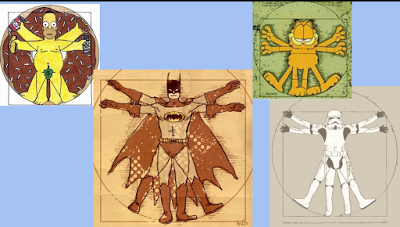
Nicole and I had been considering introducing the students to Da Vinci's Vitruvian Man. I was aware that the proportions were accessible online, that the notion of symmetry and proportion key to this art piece and theory would challenge our students understanding of the human body. Previously, we'd observed students struggling with time and how the use of technology aided in the growing understanding of the human body. It might provoke many to grab rulers and investigate Da Vinci's theories. However, we had some reservations. Firstly, could we find a child-appropriate image and would they react positively, or were we barking up the wrong tree? We decided to park the idea.
At our Tuesday staff meeting, we'd been challenged as a staff to really examine our immersion activities. What modalities of learning were we catering for? While we always looked to make activities fun or provoke feelings and often had actual experiences for the student, often we weren't integrating much learning in the activity. As a staff, we were asked to ramp up the learning quotient of experiences. Challenge accepted.


Reflecting on management's challenge and trying to find a way to put an exclamation mark on the week, we reconsidered our Vitruvian Man activity. I found an appropriate image and a few extras for a laugh, a suitable video explaining Da Vinci, and sourced the proportions/measurements.


You can imagine my anxiety levels prior to the lesson - apart from 2 of our girls I'd never heard any mention of Da Vinci or the Vitruvian Man. This was definitely taking a risk as far as creating and sequencing a learning experience.
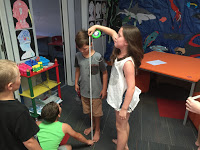

A small slideshow, the proportions listed out, making sure we have the rulers sourced, a plan of attack for observing and noticing what our learners got up to and we were ready. As they listened to the my quick introduction to Da Vinci we saw a few interested learners, then a video, a few more still, then Homer, Batman, Garfield and a Stormtrooper - lots more. Then the magic words - "we need rulers so we can measure these things!" They were intrigued, curious and we'd sparked their imagination. "Can we make a hypothesis?" says one, and gets nods of approval from some of her peers.
The questioning, curiosity, engagement and effort that went into the next 30 minutes was outstanding. Most investigated the proportions and tested (with varying degrees of accuracy) Da Vinci's theories, we spent our time recording questionings and comments from our learners or redirected them to their immersion tracking sheet as they looked to finish. All learners were introduced to something new, many were able to record quite interesting wonderings and possible projects. Not all had projects which came directly from the Da Vinci exercise, one was more interested in some of Da Vinci's other inventions and how these are compared to objects today (tanks, helicopters and catapults). Others started wondering about the human body and differences/similarities. While we had imagined that many would go straight to the rulers and the proportions, a handful went straight to devices to investigate more about Da Vinci and is an appropriate response to such a provocation, especially given our overall aim is to introduce the students to a world they didn't know.
As well as recording their noticings, wondering and questions Nicole and I were observing for teaching points for particular students. Some students were having trouble with rulers, converting measurements, working out fractions of a number or had difficulty calculating numbers. All this information was recorded to become responsive workshops for different learners. Nicole ran one such workshop today, the students with some targeted support around measurement all achieved more success using the same Vitruvian Man context. To allow student voice, we also invited students to submit requests for responsive workshops, if the students identified something they'd like to learn.
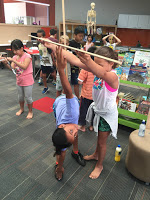
Our students finding projects isn't the only learning that comes out of these experiences. For some students, it is challenging to work with new or different people, they were actively encouraged to find someone to work with from outside their comfort zone. Others, have need support communicating their ideas, for them this was another opportunity to work with some scaffolds to find another way to share their ideas. Similarly, leading a group or being a follower is another disposition that is appropriate for some of our learners to consider during an experience such as this.
Towards the end of the experience I was buzzing, we'd achieved what we wanted when setting out but we'd done this in a way that met the criteria management had outlined in their challenge to us. I felt we'd lifted the bar for ourselves as a new team at the school and for myself personally when running immersion activities. The true test of this immersion activity, though, will come when we conference our students to co-construct their first round of projects.


Will the Vitruvian Man, or any project derived from that experience, feature amongst the children's thinking?

Perhaps, it doesn't matter as they've still been introduced to a world they didn't know existed.

Wednesday, 5 August 2015

Ask the question!

Collaborative teaching can be a scary journey! The deprivatisation might not be your idea of comfortable but it is ever present and places you in a position of constant observation by your peers, at the same time you are privileged to be able to observe them as they go about their teaching. In this environment it becomes easier to be more reflective about your own development and naturally this often takes the form of asking your colleague for their thoughts, observations, opinions and feed forward. Asking questions requires bravery and is relatively easy, being prepared to listen to the answers demands trust and professionalism.

Last week my colleague Lisa and I sat down to discuss how we might proceed with immersion and the next round of projects, we'd just conducted some eAsttle assessment of measurement and geometry and were contemplating whether or not we wanted to run one more week of immersion. I was quite excited about our ability to be innovative with the teaching of measurement but we were mindful that taking another week for immersion most likely would mean a week less for the next immersion/project phase. We both considered the timing and decided that spending a week on some measurement inquiry would benefit our learners as we can excite them about maths again.

Thursday afternoon, I spoke with another colleague, Erin, who teaches in our space 2 days a week to outline some of my ideas: Gardening, Fundraising, Garbage/Recycling and Fitness Activities/Trails. All four could be presented as problem based learning for a mini inquiry throughout the week, in my mind there would be lots of opportunities for us to observe real measurement learning and could lead to lots of responsive workshops for teaching. I got positive feedback and based on this we designed a Reggio-inspired provocation for measurement. I was still slightly concerned that three of these problems did have the potential to become more like a design thinking process though.

Friday morning, actively seeking feedback I went to share my ideas with Lisa. Her response was 'warm but demanding': "I challenge you" to look for something where there will be more DATs / explicit teaching not just an open ended exploration.  For a split second, I did feel personally attacked, but this was my own problem and wasn't in Lisa's tone, delivery or body language. I had gone seeking feedback, not reinforcement and a 'warm but demanding' response had been elicited. Shortly after I was comfortable with the challenge, I don't quite have the answer to Lisa's challenge but am feeling "comfortable with discomfort".  I have spent some time looking for better provocations and activities where there will be explicit teaching, supplementing these will be the observations that will lead to responsive workshops.

My thoughts were leaning towards using some YouTube videos and hands on activities such as building a water clock. But I'm still feeling some dissonance.

As it turned out I wasn't at school Monday ("Man Flu!" You might cry). Lisa had provided work investigating Translation, Transformation, Escher Art, Rotation, mixed with StudyLadder & Khan Academy modules and some teacher led workshops. This was a perfect model of balance for what we were after, exciting our learners about mathematics and providing room for explicit teaching.

Finding that balance can be difficult when planning for learning, sharing a learning space with other colleagues can add further pressure that translates into additional planning time. Its not a competition but it can certainly feel like it. Rather than getting caught up in destructive self-doubt, I believe that careful questioning of my own teaching and planning, should allow for deeper reflection and development. I need to bounce ideas, wonder aloud, share my observations and invite others into my thinking. But if I'm going to ask questions...

I better be ready for the answers!


Tuesday, 1 April 2014

MLB Opening Day & Maths

March 31 in the US is celebrated by baseball fans everywhere, its Opening Day for Major League Baseball and I love baseball! I'm not american, have never played baseball but I love the game and one day will be heading off to as many games as I can afford.

Anyone with a limited knowledge of American sports will understand that there is an obsession with statistics in all of the professional leagues and amongst other aspects, this makes US sport an amazing tool for maths lessons. This post is to share some of my resources, successes and some failures (professional & otherwise).

I have a very sporty maths class and I'm a sports nut, so it makes sense that I utilise this to engage the children. Yesterday, I let my passion for baseball spill into class a little in order that I build the anticipation of today. I explained that tomorrow was Opening Day and that it would be baseball, baseball, baseball.

Teaching Tools Planned
Dice baseball: There are many different versions available online but I use the following dice baseball game rules. After trying it last year, it is simple for even non-baseball players to pick up. I introduced a scoresheet also but in the end concentrated on teaching it to a couple of the more-able children.
Success: Engaging, quick addition practice, allows for high turnover of games, great for fraction work as children build toward 3 strikes = out, 3 outs = innings and 4 bases = run.
Failure: Should have scaffolded the scoresheet but was too excited.


Range of computer games: These are too practice maths skills and continue to engage the children with baseball themed maths. I found two free game sites with the appropriate type of games: Math-Play which had good decimal & fraction work; and Maths Playground which had some good maintenance work and word problems.
Success: Independent, enjoyable and ability to tailor to different needs using both sites.
Failure: n/a


GloSS cards: I prepared a set of Gloss assessment cards that were baseball themed, I did not prepare a full set of the 22 cards that we now use but just for the Stage 4 - 6 area.
Success: Some kids had a look at the cards and found them engaging. I will have these available at any stage to use for maintenance, revision or with kids struggling to engage in maths.
Failure: I spent way too long preparing these (don't ask), with a small number of kids using them this was a poor investment of time.


Baseball gloss cards from reidhns1

Baseball Stats Card: I also had decided created a template for a baseball card so that the kids could investigate some of players in their allocated teams. Any stats based research was considered valuable and this would get the kids further engaged in the whole theme. We didn't even get these out.
Success: Template made, little time invested, can be used at another time.
Failure: Inability to recognise that I had already over-overprepared!


Like all passionate teachers I arrived at school this morning excited about the day & eagerly anticipated the coming maths lesson. I even had a whole heap of popcorn to add to the Baseball Theme (I plan to take some hotdogs along at another stage - nothing says Baseball like hotdogs). In my excitement I decided that enough wasn't enough and quickly downloaded some photos to use with protractors to study angles. Surely, we would have enough work to engage & immerse everyone in baseball mathematics?

Over-planned = Yes!
Worklifebalance = So far out of kilter that my wife joked as I got off the computer last night "Oh look my husband has just got home!"
Successful lesson = Baseball - yes; teacher excitement - yes; engagement - yes; maths - yet to be decided but kids were excited and starting to see potential.

I'm planning to teach the scorecard tomorrow, that way we can investigate batting averages. I'll use the GloSS cards as an activity for some independent work as I'm not wasting them. But I've also thought of a better way to use the Baseball Stats card...

Time to go, as I'm still trying to be allowed out on the golf course!


Saturday, 15 June 2013

Highlights

Last night we had a school disco and as I watched the kids I realised that as a group we'd had a productive week and a few victories.

Matariki lesson, ako, and Maori children
We watched a YouTube clip then had a look at some Te Reo. 3 Maori children pointed out that they knew this so were given the option of creating their own posters with Te Reo phrases they wanted the rest of the class to learn. After a few hijinks one of the boys has created a cool poster, including the phrase "That's a bit dodgy", all 3 have enjoyed the choice and the ability to lead the class. Naturally, its given me some more confidence about Te Reo/Tikanga in my classroom. 
Key resources: Korero Maori CartoonCam App and Pages

Rich Tasks for Maths
Two weeks ago we started an investigation in my maths class, the students need some scaffolding to come up with questions.  This week, a student who is trying hard came up with a cool topic: "How many people get frost bite this winter?" After all of the prompting & discussion I have great hope that this will be an excellent learning opportunity, I can't wait to see what they produce. 
Key resources: Met service

Preparation for Student-Led Conferences:
On Thursday, Room 1 had a chat about what we could do to celebrate our learning when the parents come to visit in week 7. They were full of great ideas but have settled on sharing their writing through a slideshow of writing pieces, showing the parents how to make a Tellagami, having their class blog on one of the desk tops and a collaborative artwork by the parents. As a class we also co-constructed a GoogleForm asking their parents about what they've seen. How can I not feel great about a class thinking like this?
Key resources: Class Blog Tellagami App