Friday, 25 March 2016

The B word

I'm bored!

We've all heard it whispered, blurted or maybe even frustratingly said by a student. I'll admit that for me it's a tough thing to hear, I pride myself on providing a stimulating and engaging learning environment. Yet still I've seen that stifled yawn, vacuous look or just puzzlement at the reason for being there.

There are other behavioural signs of disengagement, but by confronting the B word some of these can be dealt with or headed off at the past.

At my first school, far more traditional environment, there were still many approaches to remedy the B word. Relationships are paramount, know your student and what makes them tick. Kidsedchatnz, Minecraft, personalised reading, differentiated art, hands-on learning and passion projects all were features in my teaching toolbox. But I fought to find more ways to reach more learners and stave off any nasty B-related afflictions.

With my colleagues at HPPS we push ourselves to provide an authentic and personalised programme for all learners. Projects form an inherent part of this, co-constructed from wonderings during immersion activities, they can be responsive to tailored to each students learning needs and interests. I currently have students exploring Da Vinci's machines and their modern day equivalents, with a focus on the science behind the inventions. Others are focussed on kitchen chemistry with individual concentrated on chocolate tempering, baking and one boy who is exploring the making of plastic for Lego. Our students choose what part of the day to work on their projects, while planning for workshops that cater for their literacy and numeracy needs that can't be accommodated in these projects. It is for this reason that our immersion phase is so important, exploring worlds they didn't know existed to arouse their curiosity and wondering.

But even with these projects ongoing and teachers that are forever challenging themselves to find contexts and methods to engage each child, there are still opportunities for learners to utter the dreaded B word.

Whose problem is this?

I believe it's mine. I'm fully cognisant that my colleagues at HPPS will ask me what have I done to create or change the situation (this applies to any scenario, not just the context I refer to in this post).

We've recently suffered a number of students who are attempting to occupy a healthy portion of their day with sketching, they use YouTube as their 'inspiration' and copy the steps. It's arguable that there is less creative endeavour behind the process, chess is another time filler that is enjoyed by our learners. Both are signals of the B word. Often this means that the contexts for learning are not appropriate for the individual and we need to build our knowledge/relationship to find a context/medium for more effective teaching/learning. For some it is a sign that they struggling to recognise the priorities in their learning, deadlines, workshops, literacy and numeracy goals for example. Most importantly, all of these are signals that teacher intervention is needed so that the student can be supported to more meaningful learning experiences.

In our space these time fillers are OK brain breaks, or even planned activities at the end of the day when priorities have been met. But not planned as the priority task for the day. Yes, for some sketching is a passion, and as such, it should be integrated purposefully into their learning. Some of our students successfully include many different creative arts into their projects and we use the creative arts as a vehicle to teach many aspects of the curriculum.

No doubt there are many underlying factors contributing to this affliction - real or perceived, thats for another post though.

But the B word ultimately is my problem, not theirs.

Monday, 29 February 2016

Projects, planning and provocation

enGauge 21st Century Skills
Four weeks of school are over! I know that some teachers will be up to their necks in assessment, others will be doing their best to get to know their students and some will be doing Keeping Ourselves Safe or other such topic because that fits with building relationships. Like all teachers, we've been trying to create expectations, understanding and excitement in the class, we want our learners to be engaged, inspired and innovative.

As part of this we utilise project based learning focussed around three core themes each year and the NZ curriculum is then moulded around these themes. The themes are incredibly broad, Inventive Thinking, Digital Age Literacy and Effective Communication. In 2016 we've commenced with Digital Age Literacy first. Specifically, we've chosen to focus on Scientific Literacy, with Basic (numeracy and literacy), Media, Information and Visual Literacy.

For my colleague in LC4, Nicole, I imagine this has been an eye opening experience. Its her first term at HPPS and after being in her shoes this time last year, its quite daunting; new documents, systems, learners, colleagues and school culture. How newbies make their way in this is clearly up to the individual, I found it difficult to adjust to all the challenges and am relishing my second tilt at the wheel.


When teachers discuss passion-based learning they often fret about students concentrating on the bunnies, sports and video games. Passion-based learning can lead to learners building depth in one small area and not necessarily enjoying the true breadth of the NZ Curriculum. Prior to our students beginning projects we invest time and effort into an Immersion stage. Our aim is to introduce students to a "world they don't know". An immersion activity can look like anything, a workshop, hands on activity, workstation, video, app, event, trip, expert etc. Last year I ran immersions in Lego, cooking, infographics, science, Google Doodle Competition and many others. During an immersion it is important to observe/notice what the students are up to, their questions, wonderings and responsive workshops that may be required for their learning. Projects are co-constructed with the children at the completion of immersion.


Last year, establishing how to record their wonderings was a learning process. I'd had a couple of goes at adventure learning at my previous school, but this was on a whole new level! Our first couple of immersions this year have been interesting, a video on the way the brain makes connections certainly excited our students and some activities to make them think about their senses and memory also provoked some thoughts for possible projects. But Nicole and I were clear that we wanted some more focus, and were considering contestable/challenging ideas (vaccine debate, genetic modification, climate change etc) but were naturally worried about how all learners might access these ideas. I approached one of our DPs for warm but demanding feedback, "good theme" I'm told (Prove it) "but you might want to consider an enduring understanding to provide more focus".


With this in mind we're focussed squarely on “Scientists analyze and interpret evidence to solve problems and make decisions.” But when we utilise our original idea of the misconceptions of science, we've got a huge array of scientific immersion activities that can be considered. This American list provides a number of starting points for any science learning as we move into our second week of immersion.


But immersion activities also need to challenge students, excite them and make them wonder.


Nicole and I had been considering introducing the students to Da Vinci's Vitruvian Man. I was aware that the proportions were accessible online, that the notion of symmetry and proportion key to this art piece and theory would challenge our students understanding of the human body. Previously, we'd observed students struggling with time and how the use of technology aided in the growing understanding of the human body. It might provoke many to grab rulers and investigate Da Vinci's theories. However, we had some reservations. Firstly, could we find a child-appropriate image and would they react positively, or were we barking up the wrong tree? We decided to park the idea.
At our Tuesday staff meeting, we'd been challenged as a staff to really examine our immersion activities. What modalities of learning were we catering for? While we always looked to make activities fun or provoke feelings and often had actual experiences for the student, often we weren't integrating much learning in the activity. As a staff, we were asked to ramp up the learning quotient of experiences. Challenge accepted.


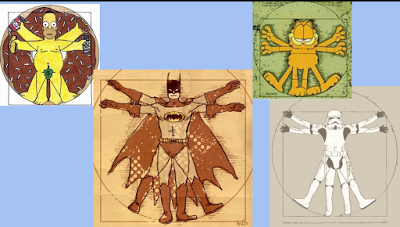
Reflecting on management's challenge and trying to find a way to put an exclamation mark on the week, we reconsidered our Vitruvian Man activity. I found an appropriate image and a few extras for a laugh, a suitable video explaining Da Vinci, and sourced the proportions/measurements.


You can imagine my anxiety levels prior to the lesson - apart from 2 of our girls I'd never heard any mention of Da Vinci or the Vitruvian Man. This was definitely taking a risk as far as creating and sequencing a learning experience.


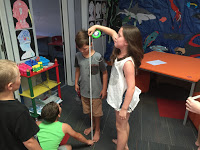
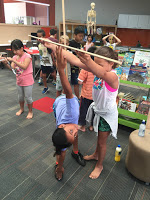
A small slideshow, the proportions listed out, making sure we have the rulers sourced, a plan of attack for observing and noticing what our learners got up to and we were ready. As they listened to the my quick introduction to Da Vinci we saw a few interested learners, then a video, a few more still, then Homer, Batman, Garfield and a Stormtrooper - lots more. Then the magic words - "we need rulers so we can measure these things!" They were intrigued, curious and we'd sparked their imagination. "Can we make a hypothesis?" says one, and gets nods of approval from some of her peers.
The questioning, curiosity, engagement and effort that went into the next 30 minutes was outstanding. Most investigated the proportions and tested (with varying degrees of accuracy) Da Vinci's theories, we spent our time recording questionings and comments from our learners or redirected them to their immersion tracking sheet as they looked to finish. All learners were introduced to something new, many were able to record quite interesting wonderings and possible projects. Not all had projects which came directly from the Da Vinci exercise, one was more interested in some of Da Vinci's other inventions and how these are compared to objects today (tanks, helicopters and catapults). Others started wondering about the human body and differences/similarities. While we had imagined that many would go straight to the rulers and the proportions, a handful went straight to devices to investigate more about Da Vinci and is an appropriate response to such a provocation, especially given our overall aim is to introduce the students to a world they didn't know.
As well as recording their noticings, wondering and questions Nicole and I were observing for teaching points for particular students. Some students were having trouble with rulers, converting measurements, working out fractions of a number or had difficulty calculating numbers. All this information was recorded to become responsive workshops for different learners. Nicole ran one such workshop today, the students with some targeted support around measurement all achieved more success using the same Vitruvian Man context. To allow student voice, we also invited students to submit requests for responsive workshops, if the students identified something they'd like to learn.
Our students finding projects isn't the only learning that comes out of these experiences. For some students, it is challenging to work with new or different people, they were actively encouraged to find someone to work with from outside their comfort zone. Others, have need support communicating their ideas, for them this was another opportunity to work with some scaffolds to find another way to share their ideas. Similarly, leading a group or being a follower is another disposition that is appropriate for some of our learners to consider during an experience such as this.
Towards the end of the experience I was buzzing, we'd achieved what we wanted when setting out but we'd done this in a way that met the criteria management had outlined in their challenge to us. I felt we'd lifted the bar for ourselves as a new team at the school and for myself personally when running immersion activities. The true test of this immersion activity, though, will come when we conference our students to co-construct their first round of projects.


Will the Vitruvian Man, or any project derived from that experience, feature amongst the children's thinking?

Perhaps, it doesn't matter as they've still been introduced to a world they didn't know existed.

Thursday, 17 December 2015

Collaboration - Power in Observation

Hobsonville Point Primary School celebrated a the work of its students last night with a small film festival. The films were all student creations, the tech support work, the MC's, Kapa Haka and musical performances all from students. I sat taking all this in, thinking about their journey as learners and it dawned on me, my own journey this year has been immense.


Reprising my journey would be rather self-indulgent ( check out these posts for the journey: seeking a growth mindsetscientist for a day,  Ask the questionSwing thoughts,  Mud,) it is more important to share about the vehicle for this journey.

The ILEs that are being built or redeveloped produce a deprivatised learning space. Sharing the learning space with 2-3 other teachers, having few walls to hide behind, colleagues strolling in and any number of visitors means every move you make is observed. This can be daunting, but it also creates amazing professional development opportunities. I've been privileged to work with amazing people this year, sharing LC4 with many but the bulk of my time has been spent with Lisa and Amy. Both are foundation staff at HPPS and have lived the journey that I undertook this year, often you can feel like you're a beginning teacher again.

In my previous school we did 4 minute walkthroughs and occasionally you'd share some learning space, this gives you a small insight into what your colleagues do and how they do it. As beginning teacher you get observed regularly and do observations of others. Deprivatisation creates opportunities for constant observation of others, their observation of you and leads to real professional development if you open yourself to it.

It it is not the formal observation that is powerful, but it is the seeing each other in action and reflecting afterwards, it is the noticings and wonderings that you share. It is the added value that you create together and the osmosis of teaching tools, strategies and each others experiences. This is the observation that you undertake together in your shared space that I am sure has made me a better teacher than I started the year. In these deprivatised environments you also get to notice how other teachers in their space do their thing and over the course of the year there are many little noticings.

Professional development this year hasn't been attending expensive courses, it has been about watching my colleagues, sharing the space together and being comfortable with constant observation.

Thanks for the year Lisa, Amy, Jody and everyone else I've shared the space with, collaborating with you in 2015 has been a whirlwind and a privilege.

Monday, 7 December 2015

Mud, Fun and a TOD

Me: Stop being so childish!

Student: But I am a child...

Prophetic words from a ten year old during an in-class activity at my previous school.  I'd prided myself on facilitating interesting and engaging activities for the classroom but these words made me chuckle, cringe and then reflect at the time. Since Friday last week they've been ringing in my ears again!

HPPS held a Teacher Only Day last Friday to plan for 2016 and for us that meant contemplating and discussing the Nature of Learning after a report produced by the Centre for Educational Research and Innovation at the OECD. There are many challenges to educators in this report, for our morning we focussed on The 7 Principles of Learning section and reflected on what challenged us or made us wonder about our own practise. 


My students have engaged in a range of projects this year, with varying success, and we have supported, encouraged and provoked their thinking throughout their journey. Understanding each child's learning needs, dispositional needs and interests has played a critical factor in the development of each project. We allow them to experience their own learning pits, but support them to make their way out of it. Some have had some very real deadlines, dealing with outside organisations, event calendars or critical milestones for their projects. This is a lot of pressure for year 4 - 6 children!

As we shared our challenges with our colleagues I wondered about this. Yes, we provide many opportunities for our learners to be stretched academically and dispositionally. But how is this affecting them? Are we overloading them? Are we demotivating them? Could they cope better with more or less? What's my role? I need to know my learners and their motivations, use my teacher voice to enable them to set realistic goals, reframe their objectives for events and projects but most importantly I need to remember they're still children, albeit very competent children. I've taught at tertiary level and while its important to have high expectations of all learners, I need to remember that there are vast differences in capacity and capability between a 10 year and a 21 year old. It seems obvious, but when you've got year 4 and 5 students running day long events and testing their self-directed skills the confusion between children and adults is easier. I ought to avoid this confusion and must celebrate the children as they do what they do best, be children.


Last Monday, we took our children up north for a snorkelling exercise. Observing them out of their regular environment provides much food for the teacher brain. They engaged in their snorkelling activities with zeal, giggles, much laughing at each other's form in wetsuits and the constant instructions from their snorkelling buddies. Throughout the day there were the constant reminders that they're children, excitement at what they saw, horsing about in the water and on land, including an irresistible urge to play in mud! What is the role you would have taken when these kids started playing in the mud? The scaffolding to their snorkelling trip had included many separate trips, experiences and activities, but on the day the magnetism of the mud won out. Children will be children after all and why stop them?

Mud can't be at the centre of all learning though, camp, projects, field trips and shows finish and we return to the classroom. The Nature of Learning challenges all educators to put children front and centre and in my opinion flies in the face of what some schools are doing when they focus on Numeracy and Literacy with little time for anything else. The National Standards don't have to be so dominant in your planning and learning design. At my previous school, my principal spoke passionately about the need for developmental play and hands on / physical activity rather than just improving each child's literacy and numeracy.

The OECD report's Social Nature of Learning recommends children be engaged in meaningful learning experiences alongside their peers, in either formal or informal situations, such situations could include those my former principal longed for. But how much power/control/ego is involved when we presume to be the font of all things educational? The Social Nature of Learning reminds us that there is much that each child can learn with and from their peers and there is plenty of other reading supporting their peers as a powerful learning tool.

Consider for a moment those stressful moments in the day and think what they might be like for your learners. There are so many reasons to integrate play-based learning, physical activity, hands-on activities or even a Reggio-inspired approach. They can mitigate much of the stress for our learners, they'll have something meaningful to do after the excitement of lunchtime, they can experience a world they didn't know exist, make genuine connections with other learners as they share their fascinations and questions,  and most importantly remove them from the grind of learning that some classrooms can become . I appreciate that this won't help them pass their next GloSS or Running Record, but perhaps it will mean your satisfying other individual needs which may result in more success across the curriculum. Prior to reading this report I felt I knew many of my learners emotionally, now I'm sceptical. We know many but perhaps our knowledge of their emotional selves isn't as deep, does it extend past the more vulnerable learners? How well do I know the emotional drivers for each child? What might I do differently to learn about these and how could that impact the teaching and learning? This wondering has me wanting to read more about anxiety, stress and other special learning needs - there goes the summer reading!

Another book laying beside my bed is Ken Robinson's Creative Schools, he worries that there are many distractions which are top of mind for educators. Consider the outside forces you encounter, political policy/agendas,  national priorities, unions, job descriptions, parental ambitions and peer pressures. Both Robinson and the Nature of Learning report place significant attention on the relationship between the educator and the learner. Compounding this, NZ teachers will be thinking about National Standards, the front/back/totality of the NZ Curriculum and possibly thinking about modern learning pedagogy or 21st century learning or some such catch phrase. Is it any wonder that teachers glance knowingly when you say that your learning design is student-centred?

I'm not trying to advocate for a fun-based learning approach, I've posted elsewhere about doing stuff versus purposeful learning and know that within my own learning common there are many structures in place to enable learners to have success. But I'm curious about the balance, particularly with so many teachers running inquiry/passion/project based learning approaches. In the drive to create authentic, connected, purposeful learning that stretches the abilities of all learners, do we run the risk of overloading them. Often times, they've not developed the skills or knowledge to understand that they're being weighed down with too much, not until it is too late anyway. And, furthermore, many children will simply take on more because they feel that they're pleasing the teacher. This is hardly creating the conditions for success. Yes, I'm in favour of students being able to make mistakes or take risks, but this should be done with the intent that they can fail forward, that next time they'll be able to rely on the experience they've gained along the way to know what to do when they face the same scenario again. How are you feeling about being a child now? It seems like being a child could be extremely taxing!

There are many features in this report and the 7 principles are only 2 pages but we need to engage with readings such as this if we are truly to live out the front section of the NZC. Many more posts will result from analysis and reflection based on this document, for now I'm pondering how are children being impacted by the many choices we make for and about their learning. Child-centred decision making is the least we owe our learners and that is more than just numeracy and literacy.

We ask so much of our learners, but for now I must remember that it's ok if they are childish!


Wednesday, 26 August 2015

Swing thoughts*

LC4 has 43 children, 3 Learning Advisors, a range of support staff, a wider network of parents & whanau, organisations that we use in a variety of ways and a supporting cast of many. We also have a large number of visitors to the school that drop by, observe, question, reflect and participate in the learning space.

Recently, I took pause to reflect on just whose space is it?  Predominantly, it is the student's space and must reflect their learning, emotional and behavioural needs, this was discussed in a blog post by my colleague Amy at the start of the year. The learning design requires considerable thought, far more than a few colourful tables or bean bags and is the topic of many visitors to our school. But it isn't just the formal planning that takes place. Another integral component are the discussions that take place every day, but there is also a layer of individual/personal choice that is part of the learning design.

Let's consider a recent two-part conversation I had:
Colleague 1 : "We could do goalfish"
Me: "no sounds a bit naff"
Colleague 1:  "it worked last year & the kids loved it"

Later on, this conversation was continued...

We were talking about how many of our learners are requiring more support with following their plan and meeting their goals, this shifted to the deprivatisation of our learning space, a display was mooted:

Me: "We could display but just not the goalfish"
Colleague 2: "I like the idea"
Colleague 1: laughing
Me: "you don't need my permission, it's not my space, it's our space".

That conversation was the catalyst for this blog post. I have wondered a lot about "permissions" this year, within the context of a shared space it seems relevant. Bear in mind, no one is asking for actual permission but there is a genuine need to be considerate. Many of the visitors to HPPS ask a similar themed question: In a shared space who decides the pedagogy? If you want to do something different to your colleagues, is this allowed/tolerated/reasonable?

How would you cope if all of a sudden you shared your present learning space with someone else? Who gets to decide on the pedagogy, management styles, planning frameworks, timelines and everything else that is part of the teachers domain? I'm not referring to your principal, team leader or mentor teacher either. I refer to another teacher in the same learning space as you, each with their own experiences, preferences, styles, strengths and weaknesses. How would you cope?

Disclaimer:
Swing Thoughts*
(Picture sourced from http://getgreatgolfgifts.com/)
At this point I must point out that these thoughts are NOT the ramblings of a teacher experiencing discontent. Merely the thoughts which are bouncing around in my head needing to find their voice. Thoughts which I raise with my colleagues and feel the need to share more widely.  

These wonderings may materialise in different aspects of the day:
  • Teachable moment - how do you run with it? What is the impact on the space/other teachers/overall plan? This means it might be parked for a later date by which time the kids may not care anymore (if they don't care was it worth pursuing anyway?).
  • Reading aloud - Scarcely done but was an integral part of creating a reading culture in other classrooms. Can you sit and read to a group of students, what if it impacts on other colleagues?
  • Innovation - How might we select which innovations should be pursued? Who judges if it is successful? If it hasn't worked for someone in the past does that mean it shouldn't be tried by a different team member?
  • Time management - What if a workshop/conference takes longer than planned? How does this impact on the rest of the days plans? How does this impact your colleague?
  • Workspace - Which space should I/we use for a particular workshop? Do I need to tell my colleague if we are heading to a different space (gym/outdoors/library/boardroom/music room/ foodtech etc).
Many of these thoughts can be dealt with effectively by considering three simple ideas.

Responsiveness: What are you responding to with any learning experience? Is it student voice? Learning needs? A suggestion/feedback from the school community? Curriculum coverage? Your own personal passions? That's The Way We Always Do It?

Collaboration: Are you adding value to the learning space? What if this is duplicating effort from your colleague? How does your learning experience/activity affect the learners as they move between teachers in the space or elsewhere in the school? Are you creating habits/expectations that may not be followed elsewhere in the school?

Permissions: Does it conform to the vision/values for the learning space/school? Is your learning activity well considered? Does it meet a need? Are you prepared to reflect on the activity honestly?

Answering questions with more questions might not seem helpful, its not meant to be. But when an opportunity/teachable moment or pedagogical shift might be on the cards I can't just act like I'm the captain of my ship. I need to consider the impact on those around me.

The cognitive load for any teacher is substantial, its certainly not lessened by being in a shared space given the deprivatisation, collaboration and sheer numbers of children. I won't claim to be a perfect teacher in a shared space (that would be extremely dangerous to believe) but I'm very proud to contribute to the many conversations that drive LC4 as a collaborative and responsive learning space. There are daily reflections, shared observations, wonderings and suggestions for how we move forward together to meet the vision and values of our school. But these all serve to contribute further to the many thoughts that bounce around inside my head!

*In golf, there are considerable moving parts to a efficient and effective swing. Unfortunately, too many thoughts about technique when taking a shot actually serves to confuse the brain resulting in a poor swing. Generally, a better technique is shown when the mind is more relaxed and in flow.  The questions and wonderings I share here are my "swing thoughts"when I'm teaching.