We all have an idea of who we want to be. Its a question that children are asked by teachers and parents and as children we all have kinds of responses. So fairy was an acceptable response for a doting father, especially when followed with a great explanation. As a 17 year old being a teacher was the furtherest thing from my aspirations, and the poor english teacher who suggested it received the type of disrespectful and tactless response that now make me cringe as a teacher. That 17 year old is still there, deep inside. But the 17 year old is mitigated by the love and knowledge of being a father of two, experience in a range of different industries, and the product of professional development, experience and challenges his early 40's self values. I have a strong awareness of the teacher I desire to be. What I have come to learn, is that my identity as leader is less clear. It may even be an identity crisis.

My experience of leadership is quite divergent, I'm fortunate to have worked for leaders in a variety of industries, organisations and titles. These have included General Managers, CEOs, Owners, Principals and Heads of Departments, and to steal a phrase, I believe I've seen the good, the bad and ugly. My own experience has included leading teams in retail and academic settings. So it was with eyes wide open that I took on some leadership responsibilities at Hobsonville Point Primary this year. I recognised that there would be obvious challenges in the range of communication, organisational and emotional demands that come hand in hand with leadership roles. I also anticipated that there was also going to be an element of things that I didn't know. Eyes wide open, but no idea of the leader I really wanted to be.
 I spent the holidays reading some introductory documentation and considering goals. Self-knowledge is invaluable, choosing goals to provide some direction in response to what I anticipated was a useful way to walk into 2019 and could be considered in terms of my HBDI profile (shown). However, it was two conversations early that resonated more, possibly even foreshadowing the impending identity crisis.
Meeting with two colleagues socially, I was taken aback when they mentioned the language of love, "Do you know your love language?" they enquired. Surprised by this sudden tangential shift, I stammered out my naïvety. As they explained what it was about how this affects them as teachers I began to see their point, knowing your learners as a leader is just as important as knowing your learners in the classroom. A little professional reading proved enlightening (https://www.5lovelanguages.com/), I could see how love languages and knowing how other teachers functioned could be part of the toolkit. But as my colleagues and I had talked that night one of them shared an important and more serious insight, "Reid, you don't have to always have the answers. Take time if you need it, it will be ok to say you're not sure".
Early in term 1, meeting formally with the leadership team, Daniel began with provocations about positive and negative experiences of leaders we'd had in the past. Three leaders stood out for different aspects I admired, several others provided examples of things I would work hard not to emulate. Reflecting on the positive qualities was somewhat useful, but it was the notion than these people were vastly different in their styles and how they impacted on my own learning. Like a recipe, it was taking these positives and adding them to the recipe of creating my own leadership style.
 The emotional aspects of dealing with people I find extremely challenging. I can be quite a blunt person but have developed a certain resilience alongside this, other experiences being blunt have taught me that if I want to live by the sword, I also have to die by it. Age (and emotional intelligence) has improved this personal trait, but I still find it hard to read body language. The combination of shooting from the lip and not reading body language is unfavourable, especially when talking with colleagues whose own thinking preferences favour emotional responses first. As a tool to help me with empathy and understanding I've read the Elephant in the Staffroom. It definitely helped as it provided an insight into the triggers for teachers in general and framed the emotional responses in several useful ways that I've considered as I've gone through 2019. My own emotional responses (which can be blunt and irrational) require management also, I don't want to jeopardise the working relationships with my colleagues or senior management team. I'm prepared to be collegial and have difficult conversations, but am finding myself taking more and more time to map out conversations in my mind and seek feedback on these conversational maps. The reading of body language and getting better at just listening has improved (the nail in the head video helped, as did The Elephant In the Staffroom). I certainly hope my abilities with this has improved but only my colleagues could truly tell me if this has improved.
What does leading in a collaborative space look like? It certainly does not look like me getting my own way and in fact, if this was the case then I'm sure the students would be missing out. I'm fortunate enough to teach with two other experienced teachers, we all have good self-knowledge but with a fair dose of our own strengths and growth areas it creates a space where there is lots of robust conversation in regards to process, choices and anything and everything that being a teacher encompasses. It is certainly not an echo chamber and nor does it demonstrate a high degree of group think, many conversations require clarification, processing time and at times things have needed to be parked in order that they can be reviewed later. Within this though, I have to admit that delegation/stepping back in some areas continues to be a challenge. Because of the experience that I'm surrounded with I know that some tasks can be completed or led by either or both of my colleagues, learning to let them do that has been a journey, as has asking them to give me some space in order that something else can be completed. Amusingly, my principal has at times asked me if I'm at the point that I need to offload something and I smile and think about the pot and the kettle.
Recently, my own leadership wonderings have been around communication, data and the effectiveness of teams. As I got through my mid-year appraisal, I was challenged to rethink my goals and agreed that I was looking for something gruntier within leadership. Partly based on my own desire to soak in as much as possible, I've been doing far more listening than sharing, especially in leadership meetings. But with an interest in all things technological, a need to develop a more analytical approach to leadership and growing our school capability in reporting, I've decided to focus on building my own capabilities in school-wide and year group level data analysis. We're in the initial years of working with Linc-Ed as a reporting system and school management system. While Linc-Ed has a huge amount of potential, pragmatically it is still a very new system and as such we need to grow our school's intellectual capital with this product. This allows me to develop a better understanding of how the data is informing our school while at the same time learning more about a technological tool, I can pass this knowledge and processing on quickly as I find it relatively easy to upskill with technology.

 Collaborative leadership can be challenging in regards to both communication and the effectiveness of teams. Getting the balance of communication correct is essential to moving your team forward, I'm not naive enough to think that this is solely about my leadership but it does bear thinking about. Setting teams up for success in meetings, informal conversations and one-on-ones is crucial and a large part of this requires effective communication. In a full team meeting I've had up to 15 staff, with student teachers present, and in a collaborative space there is lots of people wanting/expecting to have their say. It's imperative that everyone has a voice in order to encourage buy-in but is this effective? Arguably, it's not, or not all at the same time. Especially when you consider the different personalities, processing, and preferences that are at play. Hence, my beginning feelings about communication. Furthering the need to focus on communication is our school initiating it's 4 minute walk throughs again, this time I'm facilitating teams as they walk through and it is important that I lead and model these reflections appropriately. I've been looking into two different texts as a source of learning, the first Collaborative Leadership, where there is a great section on communication and secondly, The Power of Teacher Rounds to support facilitating the walkthroughs.
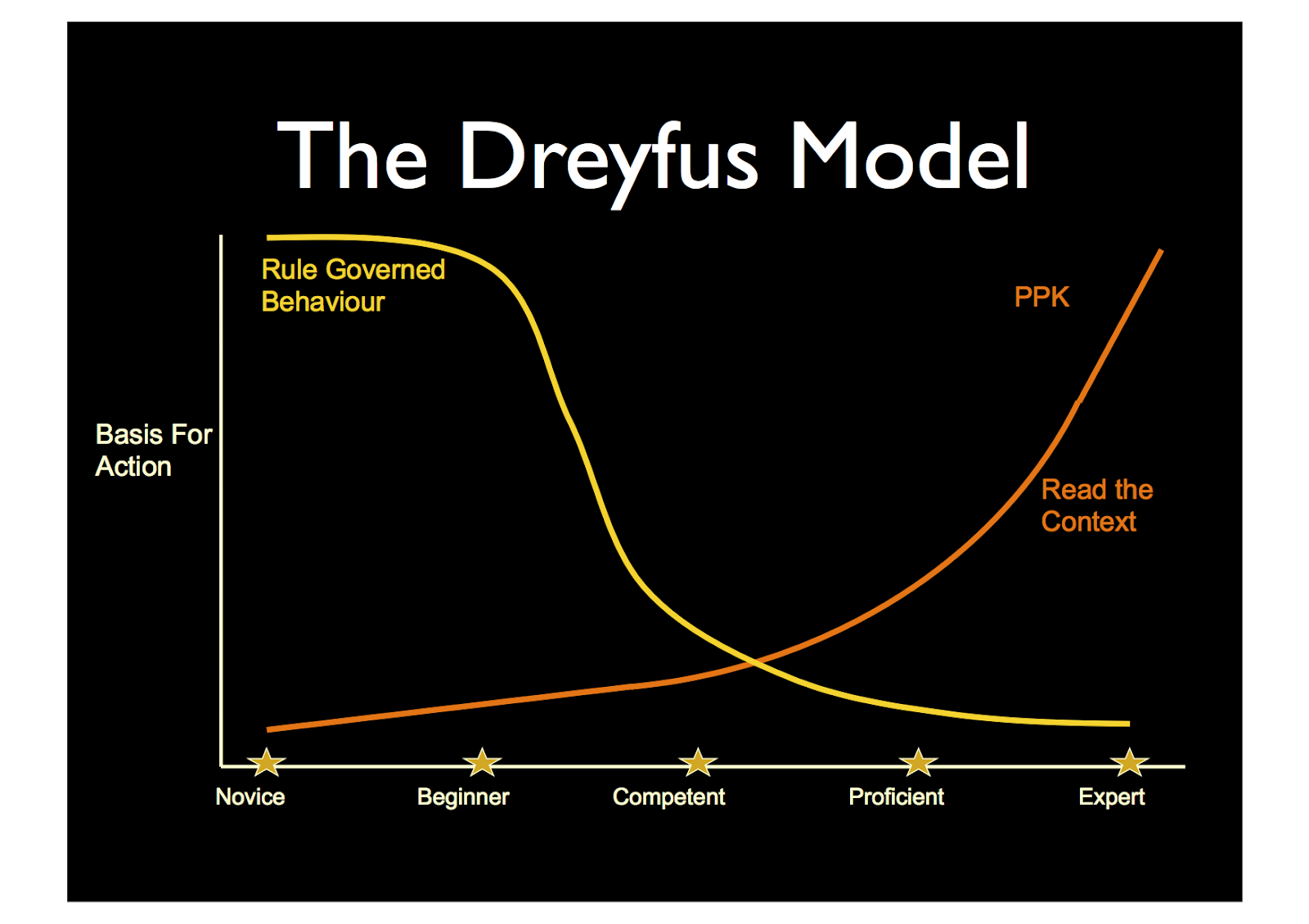 During my time at HPPS I've also had the pleasure to meet a number of the staff at Hobsonville Point Secondary and they too have provided all sorts of learning. Many of these Hobsonville Point staff, both the primary and secondary, have inspired, challenged, and given me opportunities I'm very thankful for. At other times though, I sometimes revert to type or back into the familiar (consider the Learning Pit and Dreyfus model) and comfortable, and forget to push forward with my own pedagogy. It is in the continual push forward that I become excited as a teacher, it sparks me with ideas, wonder and awe that I can then transfer into the classroom.
But this brings me to the crux of my identity crisis. Is Reid the teacher, the same as Reid the leader? Are these two people congruent, mutually exclusive or just reflections of each other? Is it ironic that many of the conversations I've had with leaders throughout my time teaching, are the same conversations I've had with others as a leader this year? It has me sometimes questioning the narratives I hear, what would I have meant if I was using the same narrative? Is this what they mean or is there a prevailing discourse that I should consider or coach for? Early in the year I had some quite significant insecurities around leadership, I know that my seniors were aware that I wanted to be seen as capable by others. Not in a deliberate, completely insecure way, but I was fully aware that if my behaviour, language, and all the components of Reid the teacher, role modelled someone who was lacking capability, then it was unlikely that teachers would look to me for support. As 2019 has progressed I've become more comfortable in my own abilities, while I still suffer from bouts of self-doubt, it is not capability-based. In preparing this blog post, I happened across the Congruence Model again, something I was vaguely familiar with but it led me to the Leadership Shadow diagram and someone else's blog. The model resonates, and the blog that is attached contains many useful reminders of things that have an impact on your leadership shadow. Implicit in the leadership shadow, is the difficulties facing someone in collaborative leadership in a de-privatised classroom, the teacher and the leader can be one and the same, affecting each other no matter how you strive to seperate them.
 |
| The Leadership Shadow. Source: https://futurepacedev.com/your-leadership-shadow/ |
Amongst my own learning has been the regular observing of a secondary colleague, every time I meet with him I find myself invigorated with an innovative edge. He reminds me of all the things that excite me about teaching, but his ability to transfer this knowledge and expertise and inspire others allows me to believe that the identity of the leader and the teacher do not have to be mutually exclusive. I need to push forward both as a teacher and as a leader, and also consider what that looks like for members of my team. In my role it is necessary to continue pushing and evolving teaching staff to build their own capacity. This is where knowledge of others becomes so crucial, the ability to read body language, understand the nuances in their behaviour and communication so that the right challenges are made at the right time. I won't naively assume that I've got this aspect right, but my own knowledge of the importance of this feature is evolving, the mere fact that it is top-of-mind allows it to be part of my toolkit.
So, where to next? Professional reading, regularly attending coaching sessions with the senior leadership team at HPPS and availing myself of time with teachers and leaders I respect is key to building my own capacity. Continuing to read and learn from avenues outside of education is also important, both as a teacher and as a leader. I count myself lucky that all those I respect see leadership and growth as a journey. Thanks to all who have contributed so far, your ongoing patience, humour and willingness to be part of the crew make it all worthwhile.