Sunday, 26 July 2015

#EducampAkl 2105

Work life balance has been a bit of a problem this year.  I've got two young kids at home, a desire to play golf, a passion to pour myself into my new school and did I mention my kids who are almost 3 and 14 weeks old. The notion of giving up a Saturday for professional development at the moment, while attractive, isn't the easiest decision.

As July 25th had approached I'd delicately mentioned to my wife that it was something I'd like to do but recognised it might not work. Thankfully the stars aligned, off to Tamaki College I trundled. Three things were crossing my mind:
  1. What F2F connections would I make?
  2. What would be my takeaways for the day?
  3. What could I offer to the others that were there on the day?
Last year my first educamp had been quite an eye opener and I anticipated lots of PD goodness this time around.

F2F connections
First of all it was awesome to meet Stuart Kelly @stuartkellynz (nice blog post Stuart), Myles Webb @NZWaikato and Amanda Signal @Heymilly. I have different connections to each of them, so it was great to meet them. I caught up with many others that I'd met before, whether fleeting or not so fleeting it is always beneficial having face to face time. Along with others, I find the connection made through Twitter is advantageous but there is nothing like the relationships and connections that are formed through real conversations rather than just 140 character snippets.

Takeaways
Play-based learning
I wasn't sure about this but with an HPPS colleague's voice ringing in my ear, I embraced the discomfort and wandered into this workshop. We're beginning some good discussion about Reggio philosophy at HPPS so I figured I had nothing to lose. One of the participants had been at the same Reggio PD with my colleague, thanks for that connection Kristyn and Amanda. I have a lot of wonderings about Play-based learning that include:
  • How might Play-based learning fit with the needs for LC4?
  • How might provocations be used effectively in LC4? Thanks for the idea of Grand or Petit provocations Caroline.
  • How would our wider school community feel about Play-based learning, especially if this was within LC4 (Year 4-6).
  • Did the #ScientistForADay inquiry have components of Play-based learning? I think it might of, I now need to reflect on whether this was successful using another lens as opposed to the original aims that Lisa and I had at the time.
I'm quite curious as to where our discussions at HPPS could take us, stay tuned I know this will lead to a blog post or two.

Google Cardboard
I didn't even know what this was prior to the start of the day, but seeing Justine Driver talk about her love of the Viewmaster as a child I knew I was in the right place. For a concise description, place your phone inside a cardboard box with some lenses to watch an app, then let the Virtual Reality App do the business! Check out Google Cardboard for a better description. Totally cool and as a toy I want one! From an educator's perspective these are also very exciting. Before the end of the session I had 4 ideas running through my brain. 

Firstly, as a simple writing prompt Google Cardboard could be exciting. We know that children may engage with activities simply because of the addition of digital technology. VR apps that could have a child experiencing another city, a tourism attraction or any such thing really opens up writing opportunities. 

Second (and third), the Hobsonville Point area and even our school are rather new. We could take photos, upload them and then allow others to experience the growth of our area and school through Google Cardboard. This has direct ties to an ongoing project at HPPS and HPSS, opportunities for some authentic collaborative projects here are massive.

The last opportunity, all credit here to @Gmacmanus (pictured). I've been taking part in an interesting little project to assist @NZWaikato and his class as they try collect information on classes so they can recreate them in Minecraft. His learners and mine are operating in quite different classroom environments, Google Classroom would provide a more realistic way to experience each others classrooms.

This was a very cool takeaway for the day, now I have to order me some Cardboard but I think I'd like to get an old fashioned viewmaster too.

What did I offer?
I took part in the smackdown by talking about one of my favourite subjects Kidsedchatnz. My involvement in this is limited to being an advocate these days, but advocate I did. I also posted a slide for #Edchatnz and all of the other education chats on Twitter. I'm glad I did this as it led to a small session where myself and @jacquea provided support for others new to twitter, chat sessions and tweetdeck. 

During this session I also chatted with Michelle Simms who is about to begin a chat session for librarians as the moderator. I know that many of us have now moderated chat sessions and I thought that I might have even seen the odd blog post or two on this, searching for posts online gets you many responses. Perhaps we need to crowd source a Moderators Guide for our Kiwi educators.

Once again, #educampakl has proven to be useful PD. The unconference style really lends itself to be whatever you need it to be, for me the connections, takeaways and ability to give back make for a powerful day. But more teachers ought to engage with educamps as they are so much more invigorating than the one size fits all approach that other PD courses tend to be. Futhermore, if you were struggling to get your school to come to the party with some PD need that you have, you'll more than likely find that need met at an Educamp, or at the very least someone who could answer your questions or point you in the right direction. 

I recognise that giving up another day seems like a big ask, but its only a few hours and never leaves you feeling like you've wasted your Saturday. I wouldn't give up the precious time with my kids otherwise! Educamps have a place in my #Worklifebalance


Tuesday, 21 July 2015

Scientist for a day

During the holidays I met with my LC4 teaching buddy to discuss our plans for term 3. We are in the midst of immersing our learners in Digital Age Literacy (see attached image), yes this goes across the term break! Initially we considered some of the activities in our planning document. But Lisa floated the idea of "scientist for a day", in a short space of time this had morphed into we what presented to LC4 on day 1 of the term.

Immersion into a world they didn't know was our main motivation, but we also wanted to excite them, provide a level playing field for some new students in our space and challenge several learner profile statements. It would serve as a great activity for us to observe many possible learning needs.

When the students arrived Monday morning they were confronted with a table that included:
Models demonstrating gears & pullies,
Newtons Cradle,
Models of the brain,
Plant Life Cycle,
DNA model,
Stethoscope,
Microscope slides with various objects.

The excitement before the had even started was fantastic!

Our first task was watching some short science videos - all conformed to the notion of snackable content. As a class we completed a PMI chart on the style of videos, this was later turned into the criteria/matrix for a science video they would create. The audience would be other HPPS students, each video would explain the particular model/concept the students had been charged with. QR codes would be used to link to the published videos.

Next we broke students into groups of 3 with peers they don't normally work with, they were given a random science model and sent off to brainstorm all their questions and prior knowledge.

Our original idea was that creating the video would take place within the day. However, the first block hadn't elapsed and we'd noticed that the day wouldn't be enough for the task. All groups were highly engaged, sharing their excitement and asking lots of good questions.

After morning tea we provided the learners with a graphic organiser to scaffold their research. We supplemented their journey with more models, texts, wonderings of our own as we modelled noticing things and asking questions to help us understand.


Lunchtime arrived quickly with talk of brains hurting and plenty of sharing their findings taking place. The final block continued in the same vein, except for a short workshop on creating a QR code, which they would need when they completed the filming.

Day 2 included plans to refresh/immerse our learners in several creative platforms (iMovie, YouTube Editor, Screencasting via Quicktime and Explain Everything).

Our learners have been busy researching, writing scripts, creating videos and  generally building their understanding of a small part of the scientific world.

So what's next?

Lisa and I wondered today about whether a second iteration would be appropriate, instead we'll allow a small group to pursue any new wonderings if student voice and needs demand it.

We contemplated whether allowing this activity to run into tomorrow is a good thing. The science literacy and basic literacy is unquestioned, our students are so busy hurting their brains with their learning. While we have shaped, nudged, modelled and questioned each group, the process and its direction has been very student-led, this has meant that very little maths has been integrated. Sharing our thoughts in reflection time as the day ended the students told us about the many measurement learnings they had had.

Students have challenged themselves with their creative skills and the sharing tomorrow shall be enlightening.

Our students have used their research skills both online and in books and we've witnessed them evaluate sources, synthesise information, skim & scan, summarise, plan, craft, and recraft their writing.

Permission to not teach and just observe has been powerful. We have many workshops we will be able to run based on our observations and the students will no doubt have many ideas for new projects, workshops and curiosities to explore. A key moment will be to complete mini-conferences to celebrate each groups learning with their whanau.

Soon we will enter our project phase. An important decision we need to explore is how might we best leverage our immersion activities so that the learning and dispositional needs of each learner is met.

Tomorrow our 3rd day of #ScientistForADay will continue.


Thursday, 28 May 2015

Modelling failure and learning

I recently ran a workshop with some children to assist them on reflecting, in talking about photos and their purpose within reflection I mentioned Thinglink. These learners appeared interested, so I quickly showed them the front page and their interest grew, so I resolved to introduce them this afternoon. 10 children attended the workshop at 1.40pm today, with no inkling of the disaster that would evolve in front of them.

I've used Thinglink with previous classes and figured that as long I knew where this was, today's session would be fine. Hence, I too wandered into my own workshop feeling sure of myself.


Thinglink generated email and passwords.
I'm using a free education account on Thinglink, this entitles me to have students loaded into a class channel using either a Thinglink generated email address and password or students can create accounts using a special code, their own email address (we are a GAFE school) and password. For whatever reasonI decided to pursue the former, within a very short space of time the learners were resplendent in a chorus of "Reid, Reid, Reid". It was reminiscent of a great 'Finding Nemo' scene and a signal that I was heading down a slippery path. They were getting mixed up between their own gmail addresses, different passwords and the Thinglink email. 

Rather than dig myself deeper, a feat I didn't think would be appreciated by the students or the observers visiting HPPS today, I decided retreat was a better option. 

I explained to the group "I knew there were two options for creating student accounts on Thinglink and I should have chosen the other option. Their calls for help signalled the first path wasn't working and I was getting into a learning pit. We need to stop and take the other path".

"We teachers also make mistakes, but it is getting out of the pit that helps us grow. If anyone feels comfortable with this job, you could go to our Learner Profile statements and pick one that you think I need to work on based on this."

A student returned with this:
When asked where I sat on this continuum, she replied that I needed more support! She was right on the money.

With some great conversation to supplement our learning, I had all the students return to the login screen to use the Class Code (right top. But the damage had already been done, the students were still confused and tried using the original Thinglink passwords with the new code, or combinations of Thinglink and their own details. Of course these combinations returned error messages similar to the picture (right below). The chorus started again and I realised I'd just run a complete disaster with very little effort. 

I gave up on the Thinglink aspect of the lesson. There was a bigger lesson occurring.

"Can everyone close their screens please. You are doing everything right but are getting error messages, it is like when a cook follows the recipe but something goes wrong.

We have two options. We can quit, go to our next jobs and forget this ever happened. Or, you can head off to your next jobs and I promise to go away and do some testing so that I can run this lesson again next week. We need to learn from our mistakes so that we can move forward in our learning. What should we do?"

Reassuringly, they all wanted to have another go.

I asked "Have you ever made mistakes and then thought it was easier to give up?"

Unsurprisingly, many of them silently nodded.

I know of many ways that I can make this lesson more successful and deliberate (within the Thinglink aspect).

  1. Run the tests myself using a dummy email. √
  2. Test with one student before running the full lesson.
  3. Write a step by step guide for logging on using the best method. Alternatively, a video would be quite useful also.
I'm hoping that the real lesson was in the workshops failure and not its success. We ask our students to reflect on their learning, its only fair that I write this reflection in acknowledgement of my own.


Thursday, 30 April 2015

Tweeting in LC4

I've been using twitter in the classroom for some time now but am constantly picking up new ways to do things, naturally we're all learning but its the launch of Twitter into the classroom that I'm specifically referring to.

Going into HPPS I was wanting to use Twitter again but was conscious that I'd need to focus my attention elsewhere first and that there would undoubtedly be differences in the approach to what I used at my previous school (blogged here). Some differences featured primarily because of the use of Kidsedchatnz and others more for the use of Twitter generally.

Here are some things we did launching Twitter in LC4 and HPPS more widely:

The launch of a laminated Tweet board for every student in LC4. There are plenty of examples on the Internet but our example allowed for students to draw their own avatar, username and the box at the bottom allows for students to retweet or favourite their peer's tweets on the wall. This is all with the purpose of creating familiarity with the medium.

When an account was established for the school it was decided that the username should be generic for the school. This would allow for minimal clutter/confusion of accounts and that I could manage this account, the school retains control through a collating usernames, passwords and security questions for all social media accounts. For the record, along with other coordinators at Kidsedchatnz we believe that all class twitter accounts should include the username for the teacher in control of the account. This means should a dodgy tweet be sent it is easy to connect with the teacher who deserves to know what their kids have done, when moderating chats with children this provides an extra layer of support that is quite helpful.

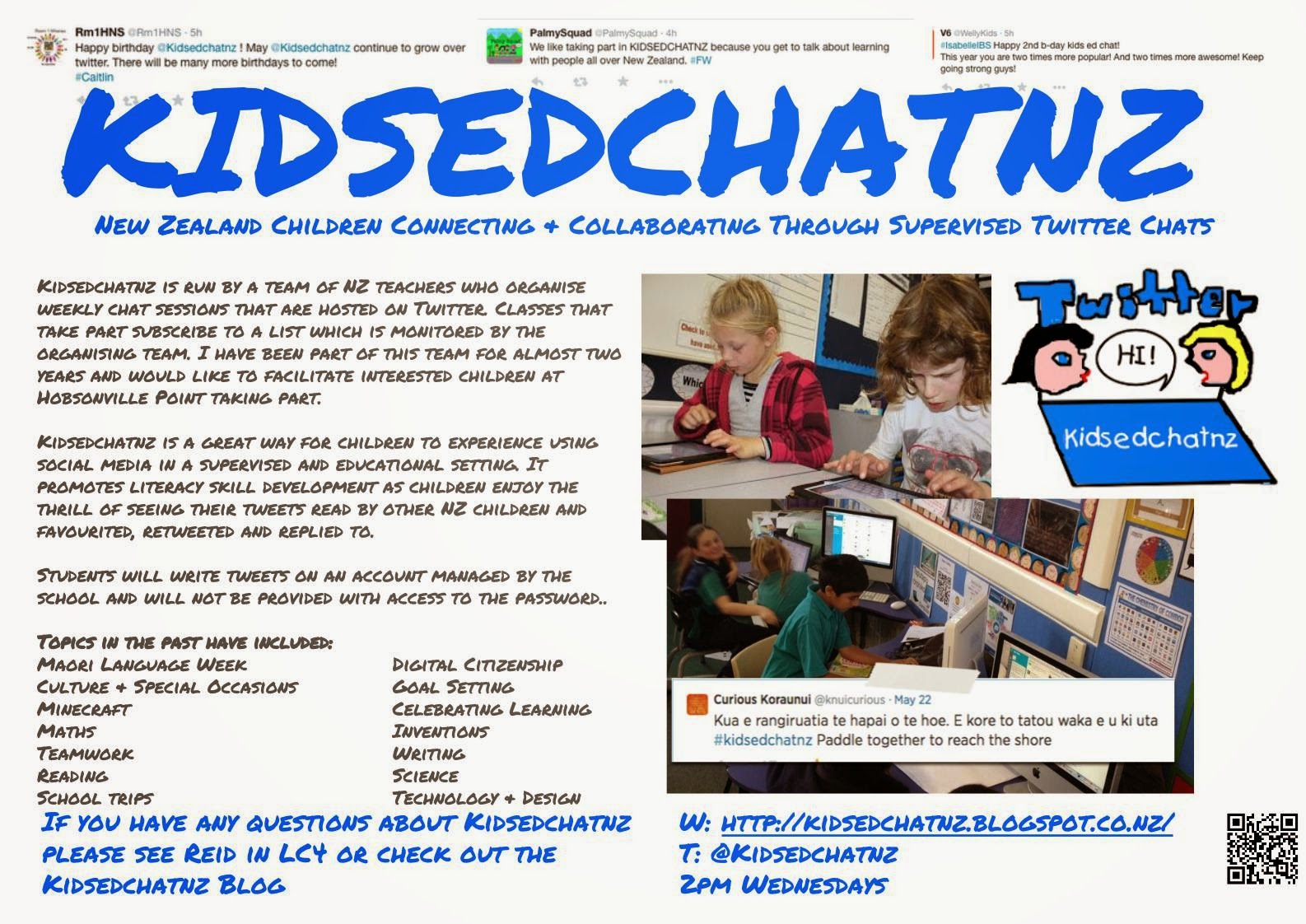
Discussion about the use of social media with my co-teacher Amy and our principal signalled that clear communication with our school community would need to take place. This was a marked difference to my previous school but in hindsight is valuable and I would recommend this regardless of school practice. I sent permission forms home outlining the purpose of Kidsedchatnz specifically, as well as placing a poster about Kidsedchatnz on the walls of both LC3 & 4 for our school community to read.

Once these components were all in place I pursued a path which is more akin to what I have done in other years. A couple of classes introducing Twitter, tweeting & Kidsedchatnz for those that are interested. When a Kidsedchatnz session is taking place I now try to ensure that the children are always in pairs so that no inappropriate tweets get through, this doesn't rule out poor spelling or off-topic tweets but that is largely a work-in-progress.

I always have the HPPS kids account on my Tweetdeck as a user column, this provides me with an ongoing record of what the kids are tweeting (as shown).

Some useful things to know if you are launching Twitter in your classroom:
It is possible to revoke permission to the Twitter App from the main Twitter website- a useful tool if you have loaded it onto multiple devices. Just go to Settings>Apps to revoke access.

You can schedule tweets through Tweetdeck, I've used this when moderating the chat sessions as it frees me of the need to post the questions and lets me concentrate on reading all the tweets.


I hope this is helpful for those investigating using Twitter in the classroom.

Any questions feel free to tweet, email or comment.


Sunday, 5 April 2015

Innovation - Term Reflection

"HPPS - wow!" you exclaim.

One of my first thoughts on heading there was how I would be able to push my creativity and innovation in the classroom. Naturally, I would look to include innovation somewhere in my personal goals. We have several goals to set, so within my own Personal Professional Development I decided that I would "Evolve my teaching through innovative and responsive practice".  I could achieve this through the following: 

  • Attend regular professional development in numeracy and literacy.
  • Implement and reflect on innovative teaching practice.
  • Regular professional reading.
I completed all my Individual Education Meetings (IEMs) on Monday and naturally teacher brain decided to redirect its energies rather than relax, reflection on innovation became the focus. How might I have been more innovative? What if this had been my previous classroom? What barriers had I perceived/removed/battled? How might I change my practice in term 2? It is also worthwhile to think about what innovation means, for me it is not a synonym for technology in the classroom. I recently stumbled across a definition (battling to find the reference right now) that included all the 'radical or incremental change' stuff that seems to be always present but for the education context included the important addition that it would add value. 

During reflection I became dubious as to whether I had been innovative and responsive, or more importantly had I added value to Learning Common 4 (LC4) or any other part of HPPS. I decided a good old fashioned stock-take was needed. I needed to simply evaluate each and every tool or idea I'd used this term and make a judgement on whether it has added value.

Kidsedchatnz:

Have introduced twitter in the classroom to LC4 and LC3. After 1 term students now opt-in on the Wednesday as part of their independent learning activities. There are some regular participants, a few who have decided it isn't for them and for some it depends on the topic. I have remained very hands-off with Kidsedchatnz this term to allow for student voice (a concern I raised in an earlier post) but am needing to check-in with participants early term 2 so they can identify some purpose for their Kidsedchatnz participation, be it literacy, dispositional or topic focussed. 

Immersion Workshop:

Week 5 we held our immersion workshops where all of our staff ran a small workshop to give students an insight into a world they didn't know. This is to help our students find their passions for the Project Based Learning. This term we were focussed on Inventive Thinking. With Caine's Arcade in my mind, my workshop was construction we had Lego, wooden blocks and stacks of cardboard boxes. My workshop was targeted for our Y0-4 learners and from the looks on their faces they had a blast inventing some pretty cool things, including tanks, time machines, boats, mermaid robots (who knew?) and towns. Construction has continued as a theme for some learners as they have created projects inspired somewhat by these early steps. Learners in LC4 also had my lego out for a time which has led to great discussion and writing.


Food Tech Workshops - Burritos & Kebabs
I blogged about this experience elsewhere but since then several projects have been initiated where food is part of the solution. I was also quite proud to hear some students talk about my food tech workshops in their celebrations for the term! 
term! 

Cricket World Cup

Heading into the CWC I had identified that there were many possibilities for integrating this into LC4. I waited to observe that I had students interested before using this in any way. I initiated a workshop early on that several boys opted in for, we brainstormed ways that the CWC could be utilised as a learning experience. They were particularly interested in bowling speeds, average speed of a bowler, the impact of technique and the variabilities created by the type of ball that is thrown. For me, new to HPPS, this was an exciting moment. Student voice, responsiveness, integrated & authentic teaching, what an opportunity! Sadly, in the hustle & bustle of HPPS and the learning journey that I was on this didn't go much further. The students managed 1-2 independent time slots focussed on their CWC work before it fell on to the back burner as they entered the immersion and design process phase for their Inventive Thinking projects. This was definitely a missed opportunity for innovative and responsive teaching, it required more steering by me but I was busy trying to juggle my first term requirements.

Design Process 

Early on Amy and I discussed using the Design Process for forming our project groups in LC4, I was excited by this as I had not used as a teaching tool nor been part of the process in any other organisation. Here was an opportunity to make additions to my kete of teaching tools while in the classroom, surely a bonus of team-teaching. I read about Amy's Design Process work with LC2 in 2014, and readied myself for learning. We took several days to move LC4 through the various phases but they came out the other end with their projects and a good understanding of why they were doing their projects. Some students even celebrated various aspects of the Design Process in their IEMs, whether it was their contribution to the ideation, the solution they'd formed as a team or how their dispositions had been challenged or grown. I see this as my first iteration through the Design Process and could write a post about it, but I think this should wait until I have taken more of a leadership role in its use in LC4, that will come when we head into our second lot of projects late term 2.

Reading Opportunities - 40 Book Challenge & Book Chat

Working with several of my readers I identified that they needed some challenge for their reading. They are all very keen readers with well developed reading ability but all tend to read within 1-2 genres. I've talked with them about a 40 book type challenge, emphasis on reading not numbers. I've used the 40 Book Challenge in class before and know it can provide some of the impetus required to take a look at different genres, thus growing our reading skills, vocabulary and general understanding of the world around us. We haven't worried about a way of monitoring the challenge because its the reading that is uppermost not writing about our reading, although Amy and I are wanting to implement some ways to provide some evidence of learning within reading. The 40 Book Challenge awaits as an untapped tool that I have introduced to LC4.

A colleague in Christchurch has developed a twitter-based book chat with her students. I had two of my students participating last year as it provided them with an opportunity to regularly discuss the books they were reading and expand their reading horizons. I have mentioned the existence of this bookchat to some of my students but need to facilitate their participation early in term 2. 

Where to next:
As we reviewed Term 1, I shared my frustration with my self-diagnosed lack of innovative teaching. I knew that my first term would be challenging in a new school but that I didn't feel I'd met my own expectations. The conversation took an interesting spin as we considered the impact our planning had had on this. We'd started with the lofty goal of having every week well planned in advance but ended operating on a just-in-time model as we responded to the needs of our learners. We discussed how this would have a large impact as more planning equates to a longer lead-in time and therefore more time for innovative teaching. Twitter chats, food tech lessons and construction workshops all necessitate preparation and use of any technology is enabled by more prep time also. However, directing a child to a website or app upon a teachable moment doesn't require much prep, just that the tool is top-of-mind at the required point in time.

During these discussions I was reminded of a blogpost that our principal shared with us in our innovation community. It centred on the importance of finishing, that completing a process or inquiry of learning is powerful and allows the learner to practice, develop and understand the various components required for mastery. It provided a challenge, the idea that innovation can lead to lots of uncompleted pieces of work. This reading summed up a conversation I had with another colleague about artistic endeavours that can lead to vast quantities of half-finished work, and frustration for a teacher that the true learning hasn't taken place yet.

In the last week of term 1 Amy was busy downloading information to me that may be helpful in term 2. Learning to operate our robots and what she had done for Coding within HPPS was high on the priority list. It was exciting being the learner again and in the short space of time we spent on this, combined with the reflection about my own innovative practice I felt invigorated. 

I'm still not sure if this was just my own self-doubt created by higher expectations, but the goal deserves the honest reflection and now I have a clearer pathway for term 2. Student voice, innovative teaching practice that adds value, advance planning and all tempered by a renewed emphasis on finishing experiences fully.